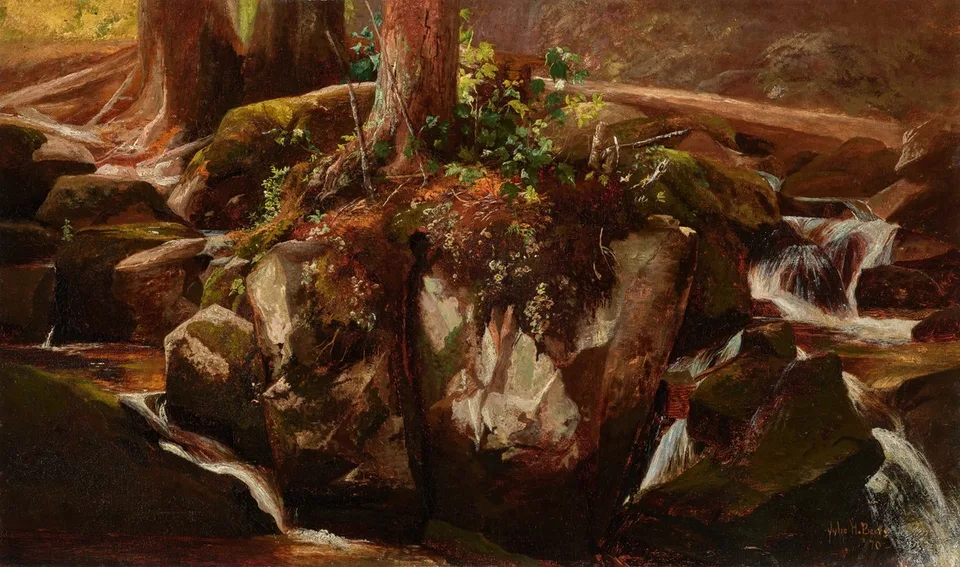
 United States · 1870
A Mountain Stream
Julie H. Beers (American, 1835–1913)
oil on canvas
Julie Beers brings rock, roots and water close; Sanford Robinson Gifford spreads a homestead beneath a broad mountain view. The museum proposes a White Mountains location for Beers and identifies Mount Hayes for Gifford. Compare scale and attention while preserving that difference in geographic certainty.
United States · 1870Julie H. Beers (American, 1835–1913)
oil on canvas
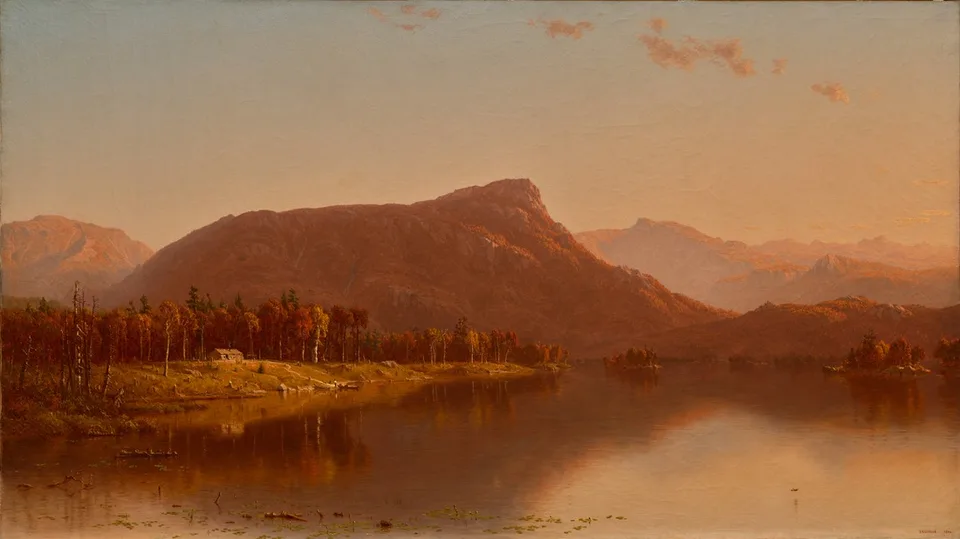 United States · 1866
Sanford Robinson Gifford (American, 1823–1880)
oil on canvas
Beers’s mossy boulder fills much of the image, inviting inspection of stone and small plants. Gifford’s cabin occupies a tiny clearing within a large landscape. The viewer must work differently to notice local details at these two pictorial scales.
Small cascades divide around Beers’s rocks. Gifford’s canoe connects the quiet shore with a supply journey. Water is visibly active in the first and supports a documented human movement in the second, without making either painting a complete environmental account.
Exposed roots grip rocks in Beers’s close view; cut stumps mark Gifford’s cleared bank. Both are precise tree-related details, but one reveals growth around obstacles while the other records deliberate removal to create a homestead.
The paintings do not supply complete land histories or equivalent geographic evidence. Their composed visual calm cannot establish the absence of human impact or earlier inhabitants.
The comparison of visible choices is our own reading. Follow either artwork page for its full context, uncertainty note and image-rights record.
Close observation, panoramic views, construction and an arranged encounter with birds.