Nature and human choices
These works offer different ways to organize nature for a viewer. A close stream study differs from a panoramic lake, while a dam and a homestead make human intervention explicit. A dramatic bird composition adds another kind of arrangement. Follow those choices without treating a calm image as a complete history of a place, an ecosystem or its maker.
Begin the journey ↓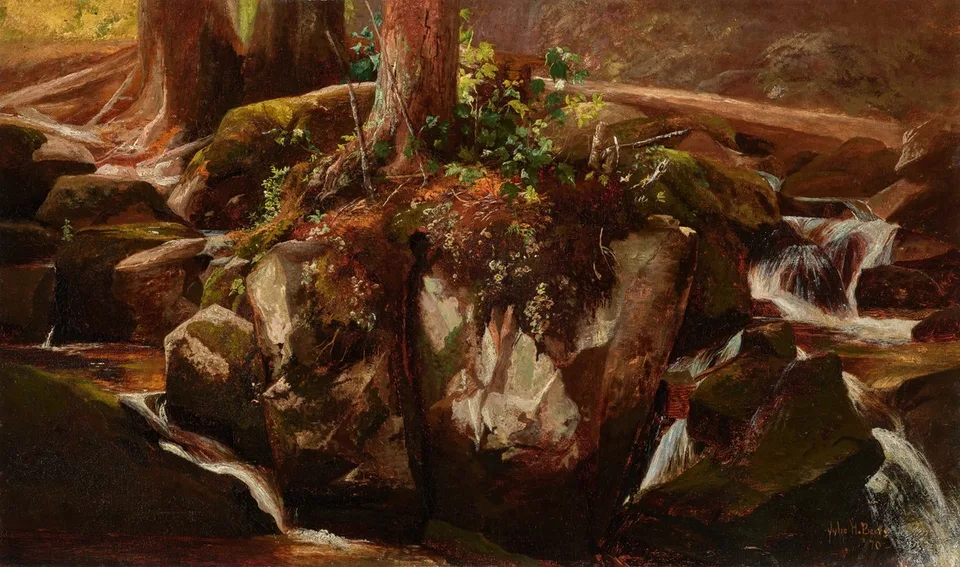
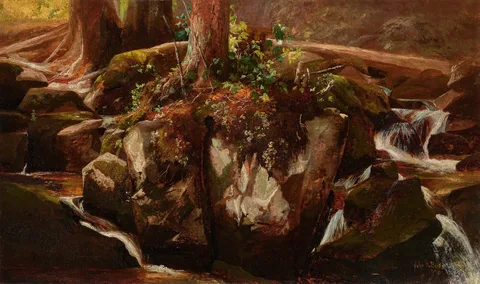
A landscape at close range
The large mossy boulder makes local variation the subject. Follow its plants and exposed faces before looking for a distant vista; the probable White Mountains location remains less certain than the visible structure of this close view.
Carry this question: What becomes important when the horizon is excluded?
Open the artwork ↗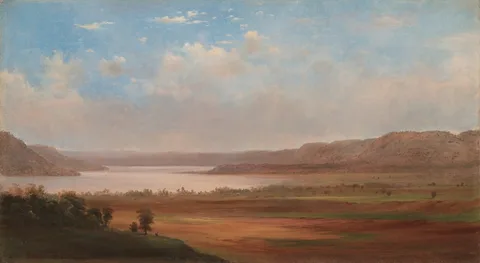
A panorama opening outward
The pale lake widens toward the viewer and narrows into the distance. The museum connects the view with Duncanson’s journey, but its calm effect does not by itself establish his feelings or the region’s wider wartime experience.
Carry this question: Which edges guide the eye toward the distance?
Open the artwork ↗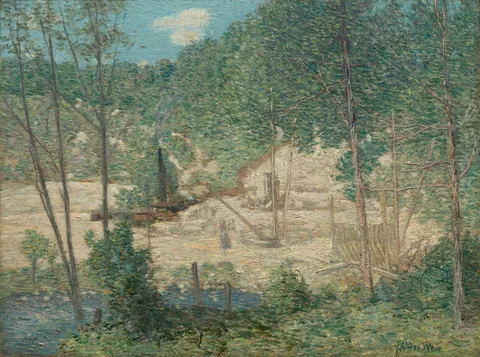
Construction through the trees
The pale worksite appears through a screen of vegetation. The museum identifies Scotland Dam under construction and notes the painter’s household benefited from its power; the scene is also a record of a changing local landscape.
Carry this question: How do the foreground trunks affect your view of the worksite?
Open the artwork ↗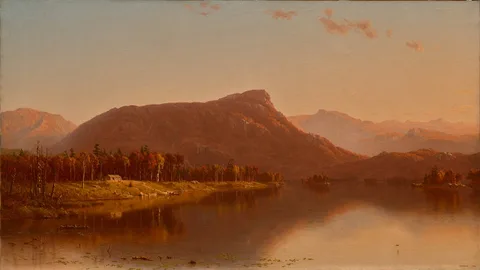
A clearing with visible traces
The cabin occupies land made open among the trees. The museum identifies the stumps as evidence of cutting, so the title’s “wilderness” should not make the landscape seem untouched or previously empty of people.
Carry this question: Which small marks reveal the creation of the clearing?
Open the artwork ↗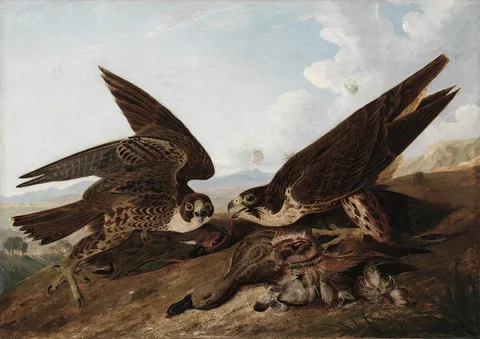
A dramatic constructed encounter
The opposing wings make the birds’ action emphatic, but the composition is not a direct record of one hunt. Read its natural-history ambition alongside the documented history of Audubon’s slaveholding and looting of Indigenous graves.
Carry this question: How do the wing directions organize the entire scene?
Open the artwork ↗Look at a pair more closely
- Close stream, distant home
Beers and Gifford offer different scales of looking at New Hampshire landscapes.
Read with the sources
Historical context follows the individual museum records linked on each artwork page. These routes make original comparisons of visible form; resemblance alone is not evidence of shared meaning or direct influence.