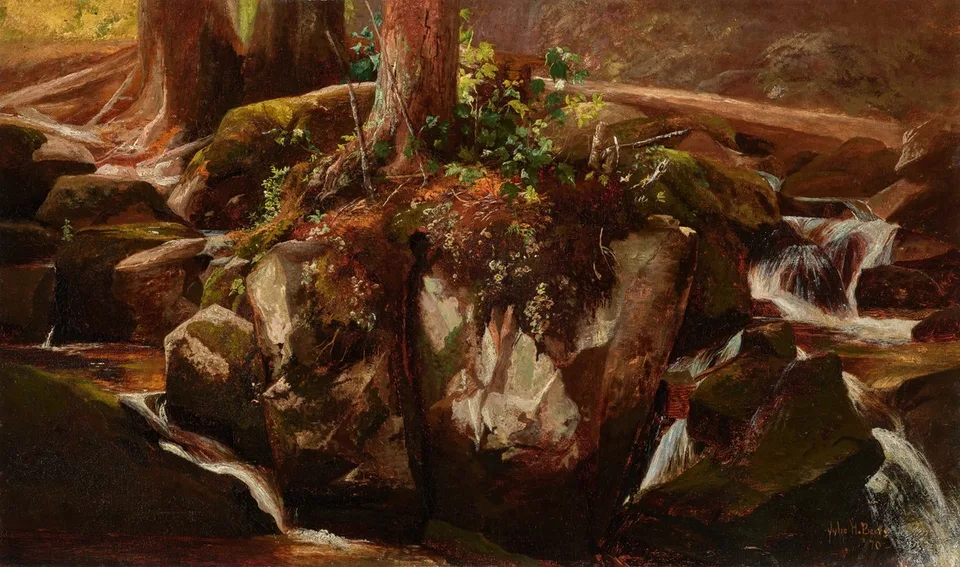
Julie Beers places us close to a mossy boulder, where divided streams and exposed roots make a small landscape feel richly inhabited.
Julie H. Beers built a successful career as a landscape painter while women faced substantial barriers to professional art. She also earned income by leading outdoor sketching trips for women in New York and New England. The museum suggests that this painting was made during her 1870 visit to New Hampshire’s White Mountains, although its exact location was not recorded. The small, low viewpoint favours close attention over a panoramic mountain prospect.
The central boulder becomes a landscape within the landscape. Pale angular faces meet dark crevices, while moss and tiny plants soften its upper surface. Water divides around it into separate narrow paths, and exposed tree roots continue the branching movement above. Rather than searching for a distant horizon, follow these local connections of stone, growth and flow. The painting’s intimacy does not mean a lack of complexity: it organizes several materials and changing surfaces within a tightly bounded view, making observation itself the main event.
The White Mountains location is likely, not documented. The painting offers a composed view of a stream and should not be treated as a measured record of a specific geological site.