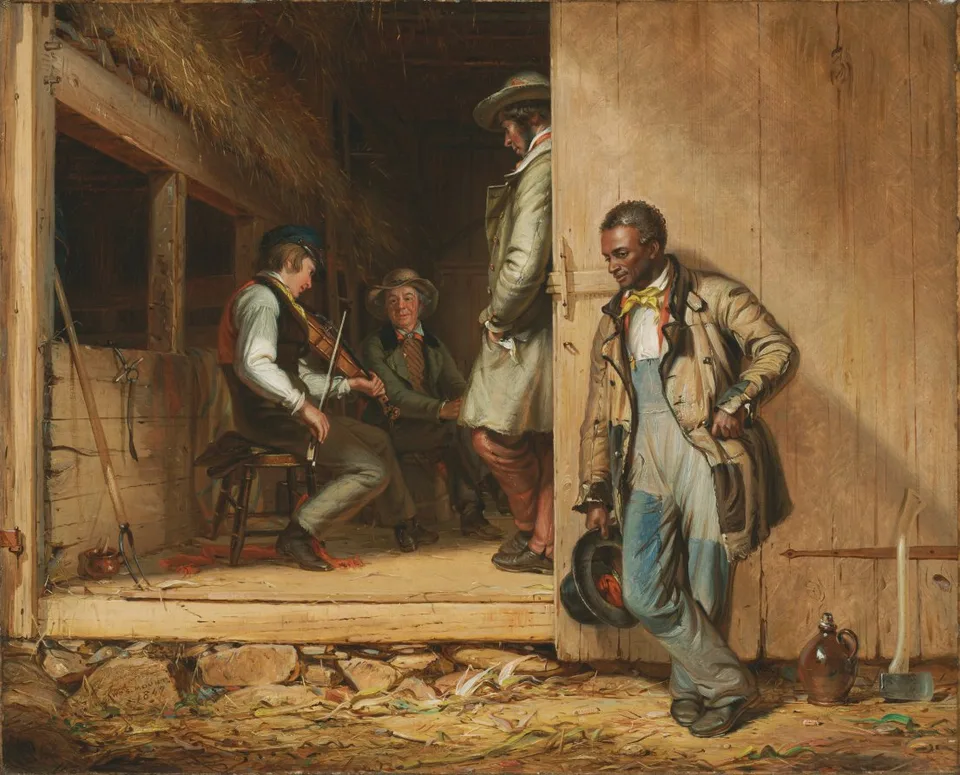
 United States · 1847
The Power of Music
William Sidney Mount (American, 1807–1868)
oil on canvas
Listening and winding yarn both connect people across space, but the separation has different meanings. Compare the visible arrangements before allowing a familiar idea of companionship to obscure racial boundaries or historical courtship conventions.
United States · 1847William Sidney Mount (American, 1807–1868)
oil on canvas
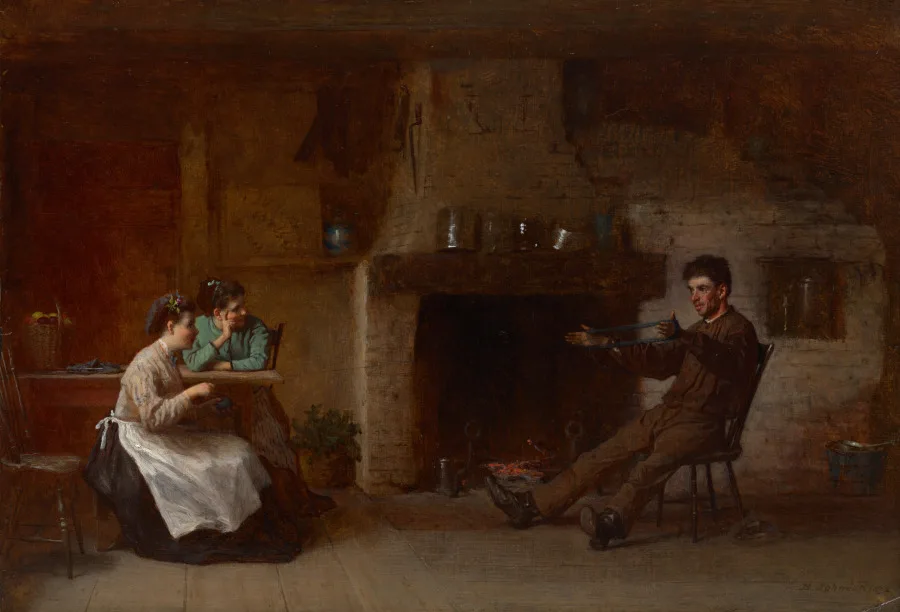 United States · 1872
Eastman Johnson (American, 1824–1906)
oil on board
The fiddle’s sound reaches an outside listener, while a loop of yarn physically links two people within a kitchen. Both activities connect separated bodies. Their practical structures are different, and the museum supplies distinct social contexts for the connections.
Mount’s Black laborer listens outside the white men’s gathering. Johnson’s second woman watches and may be a chaperone. Both figures affect how we understand the central activity, but their positions and possible roles should not be treated as interchangeable examples of social exclusion.
Mount’s door organizes racial separation in the composition. Johnson’s hat on the floor contributes to a comic reading of manners. A large architectural boundary and a small misplaced object operate at different scales, each connecting visible arrangement with historically specific expectations.
Racial separation and courtship etiquette are not equivalent forms of constraint. The comparison uses shared activities to clarify differences in access, role, and historical stakes rather than to flatten them.
The comparison of visible choices is our own reading. Follow either artwork page for its full context, uncertainty note and image-rights record.
Shared activities can connect people without making their situations equal.