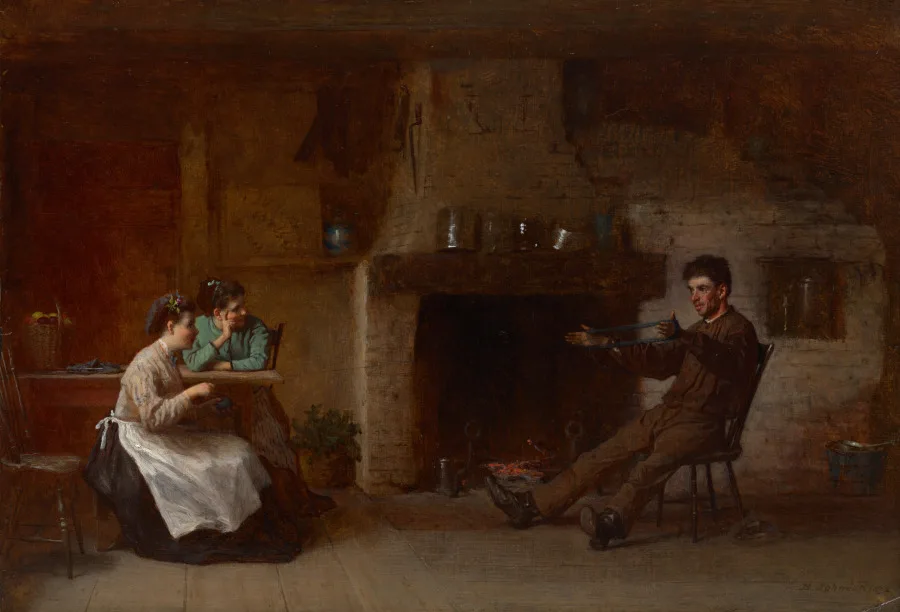
A strand of yarn links two people across a room, turning a household task into a lightly comic courtship scene.
The figures sit apart, yet the yarn connects them. The woman gathers it into a ball while the man holds the loop open across his extended hands. A second woman watches from behind. Between the pair, the large dark fireplace gives the small cooperative task ample room to unfold, making distance itself part of the composition.
The museum identifies the setting as a Nantucket kitchen and explains winding yarn as a familiar nineteenth-century courtship motif, with a joke about a woman entangling a suitor. It suggests that the second woman may be a chaperone. The man’s sprawling pose and hat on the floor add comic details that contemporary viewers could read socially. These interpretations depend on historical conventions rather than yarn carrying one meaning everywhere. Compare the task’s physical cooperation with the space separating the bodies: domestic work becomes a way to suggest a relationship without depicting an explicit declaration of love.
The chaperone identification is likely rather than certain, and the courtship meaning depends on contemporary convention. The painting does not provide named sitters or a transcript of their intentions; yarn-winding is not universally a romantic symbol.
How should the second woman’s role be described?
Practise looking at Winding Yarn (Interior of a Nantucket Kitchen) →