Work, waiting, and company
A small task can explain why figures occupy the same space. Carving, rowing, listening, and winding yarn each create visible relationships, but those relationships carry different stakes. Follow hands and bodies before deciding what togetherness means. These scenes range from military waiting and athletic coordination to courtship conventions and racial separation, so their similarities should sharpen their differences rather than erase them.
Begin the journey ↓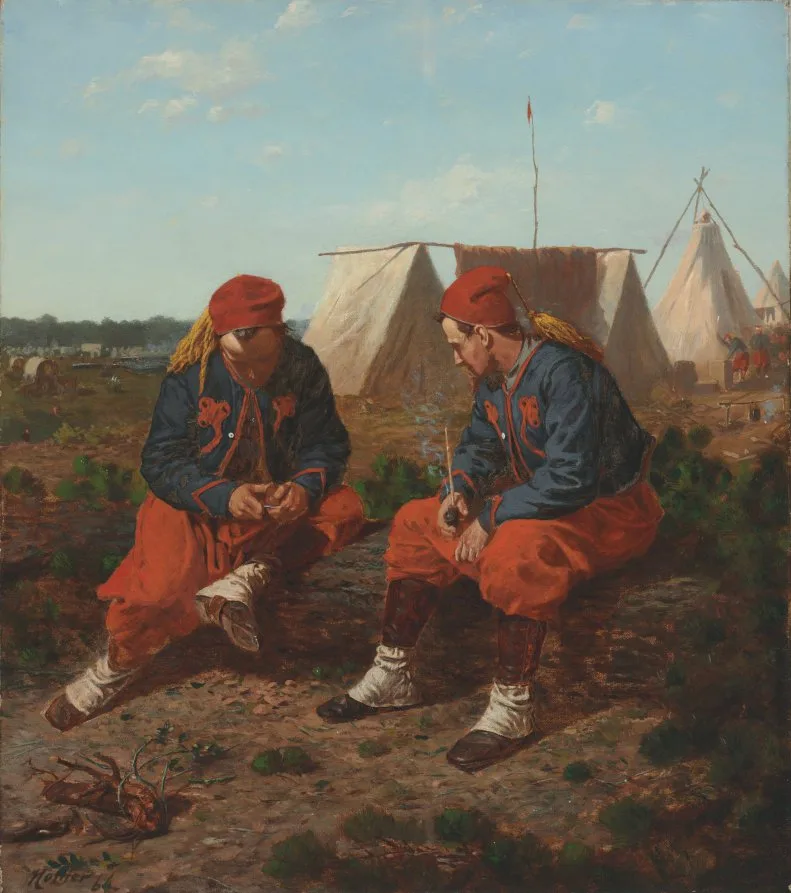
Company during a pause
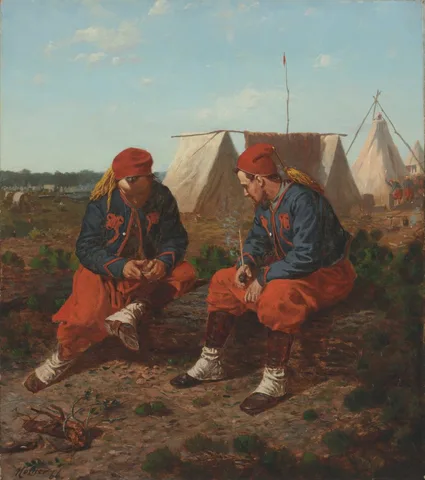
The carving soldier bends toward his work while his companion watches with a pipe. Their shared uniform connects them, but their hands perform different actions. The museum places this quiet interval within the Civil War, showing that waiting and minor tasks also belong to the representation of conflict.
Carry this question: How do the two men’s different activities hold the pair together?
Open the artwork ↗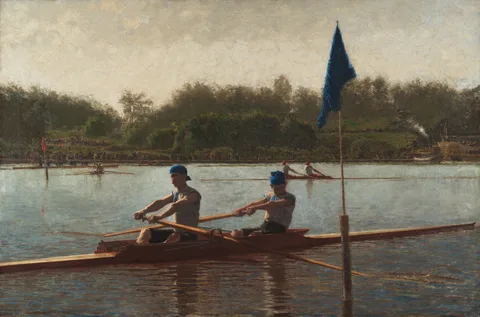
Coordinate under pressure
The rowers require more exact physical cooperation. Their repeated caps, arms, and oars make teamwork visible as they negotiate the halfway stake in a documented race. Unlike the soldiers’ pause, this shared activity depends on timing and direction, which the composition makes readable through related bodily positions.
Carry this question: Where are the rowers similar, and where do their poses differ?
Open the artwork ↗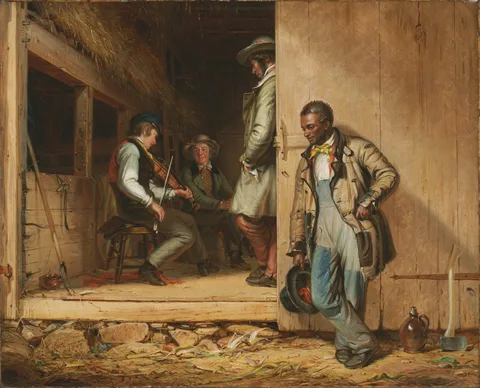
Follow a boundary
The fiddle tune reaches everyone, yet the broad door separates white listeners inside from a Black laborer outside. Shared attention does not mean equal access to company or space. The museum makes that racial division central, asking us to notice both the connection and its limits.
Carry this question: What would disappear from the reading if you ignored the doorway?
Open the artwork ↗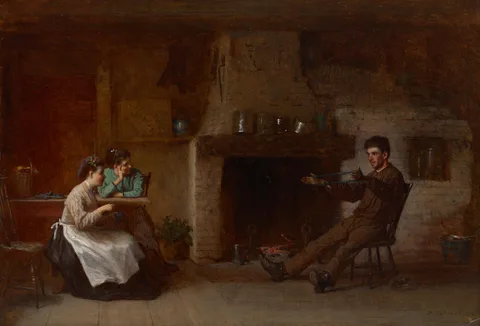
A task with a social convention
The yarn stretches between two seated people, giving their distance a practical connection. The museum identifies courtship associations and a possible chaperone. The relationship is suggested through a shared household task, but historical convention supplies meanings that the visible thread alone could not prove.
Carry this question: Which part of the courtship reading depends on context beyond the visible task?
Open the artwork ↗Look at a pair more closely
- Who shares the room?
Mount’s music and Johnson’s yarn-winding
Read with the sources
Historical context follows the individual museum records linked on each artwork page. These routes make original comparisons of visible form; resemblance alone is not evidence of shared meaning or direct influence.