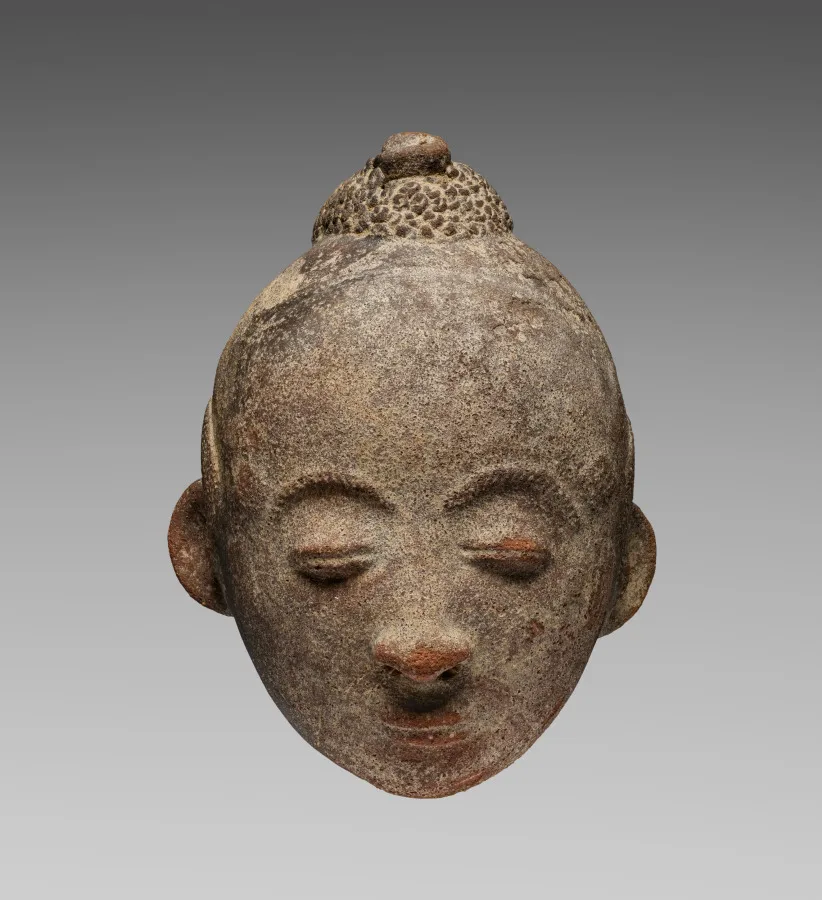
 Ghana, Akan-style sculpture, unknown female ceramicist · late 1600s–early 1700s
Memorial head (nsodie)
Unrecorded female ceramicist, Akan tradition
Terracotta
Both heads create a concentrated encounter, but one belongs to an Akan memorial tradition and the other represents an Egyptian deity. Compare modeled features, symmetry and the effect of the photograph without confusing commemoration with divine representation.
Ghana, Akan-style sculpture, unknown female ceramicist · late 1600s–early 1700sUnrecorded female ceramicist, Akan tradition
Terracotta
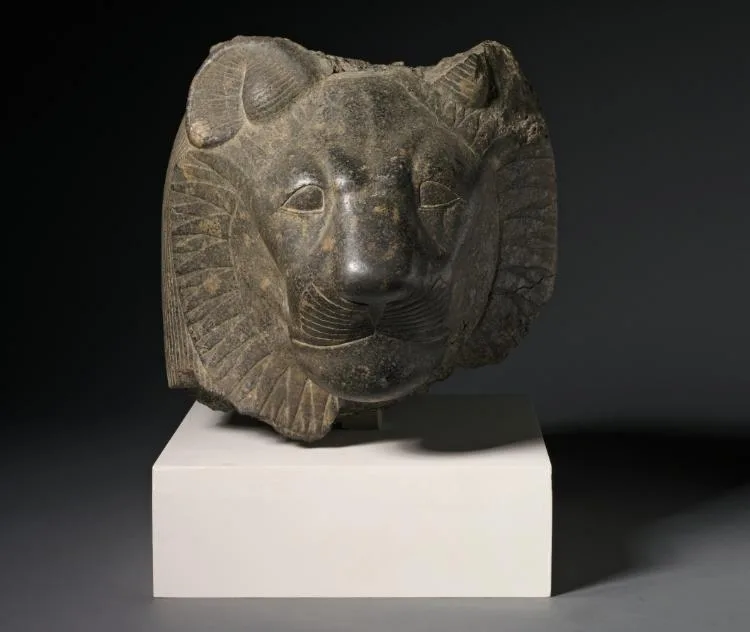 Egypt, Thebes(?), New Kingdom (1540–1069 BCE), Dynasty 18, reign of Amenhotep III (1390–1352 BCE) · c. 1391–1353 BCE
Maker unrecorded
granodiorite
The Akan head’s lowered eyelids and Sekhmet’s projecting feline muzzle create different focal points. Small changes in projection control light and shadow. Describe those forms before assigning a private emotion to the royal sitter or reducing the deity’s identity to an expression.
Small curls gather into the Akan head’s raised hairstyle. Around Sekhmet’s feline face, a patterned ruff overlaps the heavier forms of a wig. These are different ways of framing a face; the museum connects the Akan hairstyle with the royal subject’s individuality and Sekhmet’s wig with her divine representation.
The Akan sculpture is catalogued as a memorial head, with a carefully modeled mouth and face. Sekhmet’s head survives from a larger statue, and its broken upper edge lacks former attributes. Do not automatically imagine a missing body for every separately displayed head: their original forms and histories differ.
Neither image should be treated as a generic representation of ‘African belief’. Their histories, materials and cultural contexts are distinct.
The comparison of visible choices is our own reading. Follow either artwork page for its full context, uncertainty note and image-rights record.
Who is made visible, and on what terms?