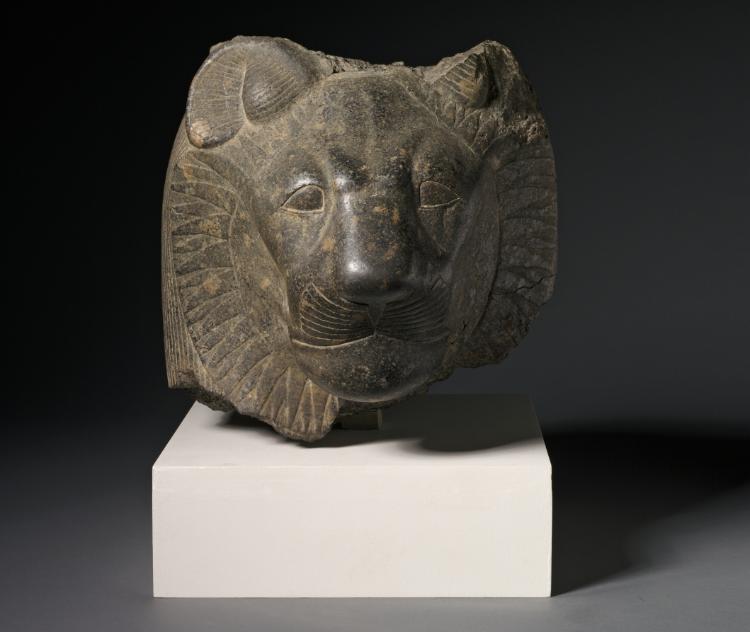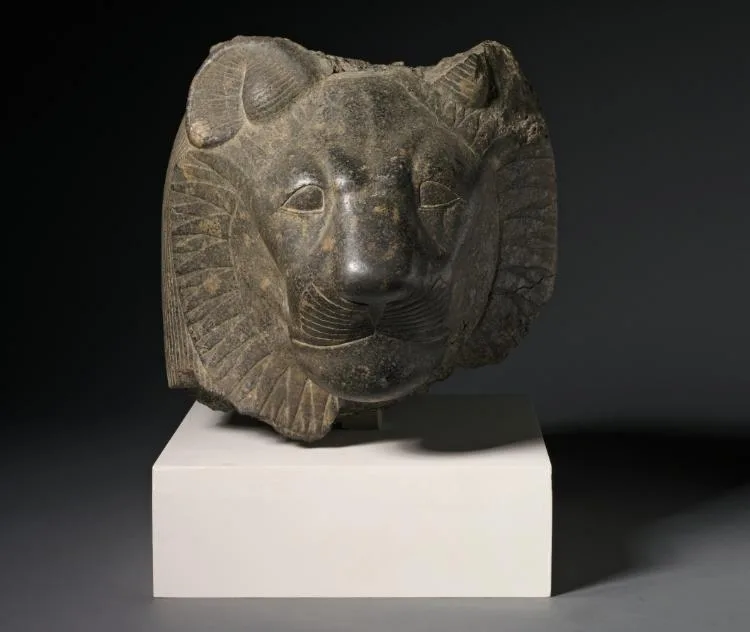
A lioness face, a patterned ruff and a broken crown turn a fragment into evidence of a much larger divine image.
The surviving head is already imposing, even without its body or crown. Its broad muzzle projects toward us, while a stylized ruff spreads around the face. The stone alternates between smoothly modeled features and sharply defined grooves, so the sculpture invites both recognition of an animal and attention to deliberate pattern.
The museum identifies the goddess as Sekhmet and places the head in the reign of Amenhotep III. He commissioned many large images of the goddess, possibly invoking her healing powers. This head probably belonged to a seated figure and likely came from Thebes; a later move to the temple of Mut is also possible. A wig and the former sun disk and cobra linked the lioness-headed deity to sacred and royal authority. These details help identify the figure, but not every missing part can be reconstructed with certainty. The museum photograph also includes a modern display support that should not be mistaken for part of the ancient work.
The original seated pose, exact location and later movement are qualified proposals. The sun disk and cobra are no longer present; their former existence is supplied by the museum’s interpretation, not visible completeness.