Pictures and power
Art can give authority a visible form. Scale, posture, placement and costly material help do that work, but no single device has the same meaning everywhere. A museum display also changes an object’s setting. Read these works with attention to original purpose, known history and the limits of the surviving evidence.
Begin the journey ↓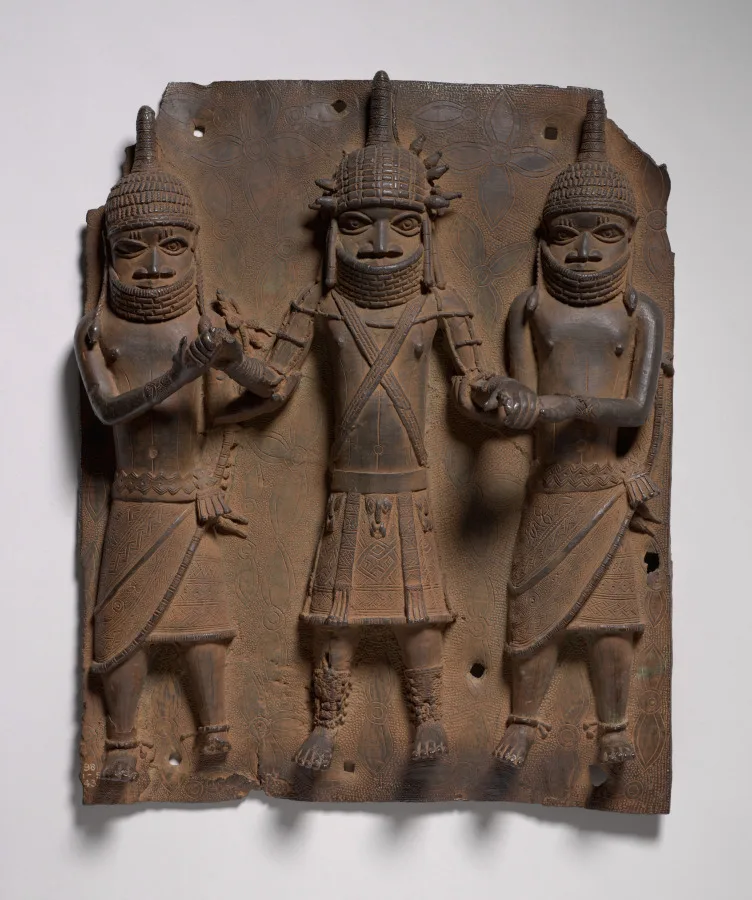
Hierarchy on a court surface
Compare the central and surrounding figures. The plaque belongs to a royal setting, and the museum records a later colonial seizure. Both the represented hierarchy and the object’s displacement belong in its history.
Carry this question: How is importance made visible without a written label?
Open the artwork ↗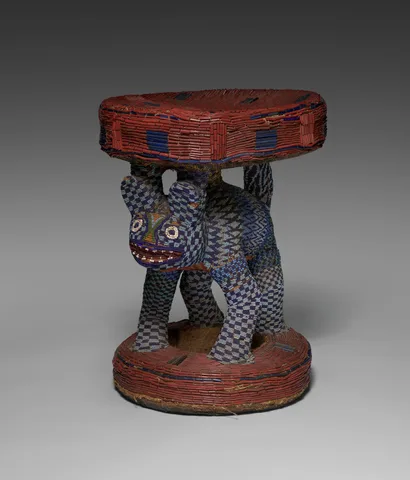
A seat as a statement
A leopard supports the bead-covered seat. In the Bandjoun context documented by the museum, this animal signals royal status and beliefs about a ruler’s transformation. The record identifies a travel stool used for smaller palace ceremonies, so its imposing decoration need not imply a large public throne.
Carry this question: How would adding a seated person change the composition?
Open the artwork ↗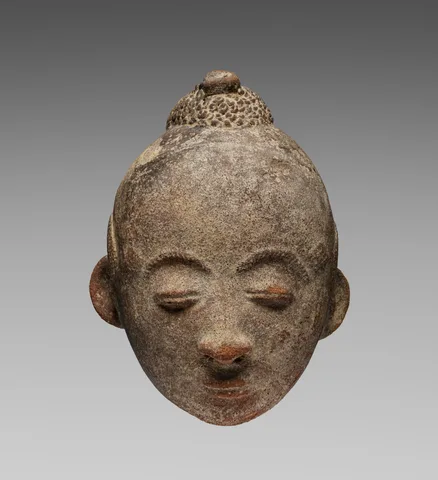
Remembering through a face
The museum identifies a memorial role. Attend to the modeled face and its distinctive details while resisting the assumption that the object is a straightforward likeness in the modern portrait sense.
Carry this question: Which features make the head individual, and which seem deliberately ordered?
Open the artwork ↗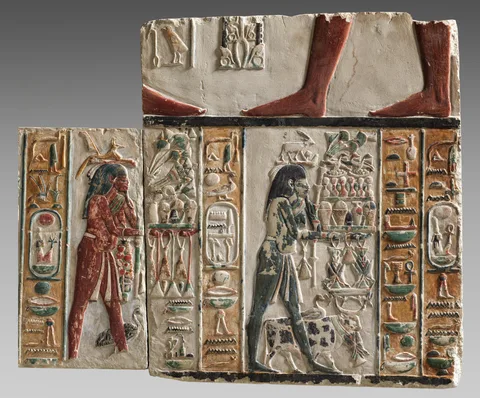
An image larger than its fragment
Two bearers are visible in this photograph, each carrying offerings in the lower register. The museum describes four provincial personifications across the larger wall ensemble. Separate the two figures you can inspect from the complete procession described in the record; the fragment’s edges matter.
Carry this question: Which two figures are visible here, and where does the surviving wall end?
Open the artwork ↗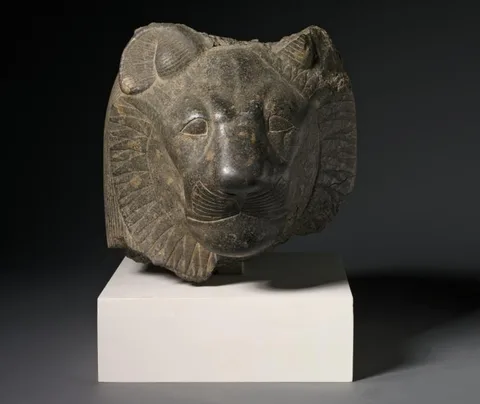
Presence through a powerful form
The lioness muzzle, stylized ruff and surviving wig belong to an image of Sekhmet. The museum connects this head with the statues commissioned by Amenhotep III, while qualifying its exact original setting and pose. The crown and body are incomplete: distinguish the surviving carving from the proposed reconstruction.
Carry this question: Which features are present, and which parts must be understood through the record?
Open the artwork ↗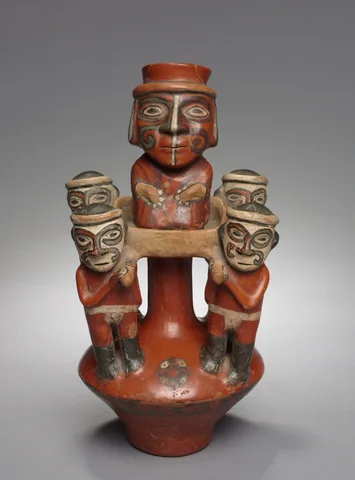
Status carried by an object
Read the modeled figures and carrier structure together. The museum’s account connects the represented scene to status. The ceramic vessel translates a social relationship into a compact three-dimensional image.
Carry this question: Who appears to carry, and who appears to be carried?
Open the artwork ↗Look at a pair more closely
- How a face holds attention
An Akan memorial head and a head of Sekhmet
- Status raised from a surface
A Benin royal plaque and a Maya royal woman
- Carrying and representing rank
A Chimú litter part and a Wari vessel show two relationships with transport.
Read with the sources
Historical context follows the individual museum records linked on each artwork page. These routes make original comparisons of visible form; resemblance alone is not evidence of shared meaning or direct influence.
- Royal plaque with attendants — museum collection record
- Prestige stool (Kuo fo) — museum collection record
- Memorial head (nsodie) — museum collection record
- Nome Gods Bearing Offerings — museum collection record
- Head of Sekhmet — museum collection record
- Vessel with Litter Group — museum collection record