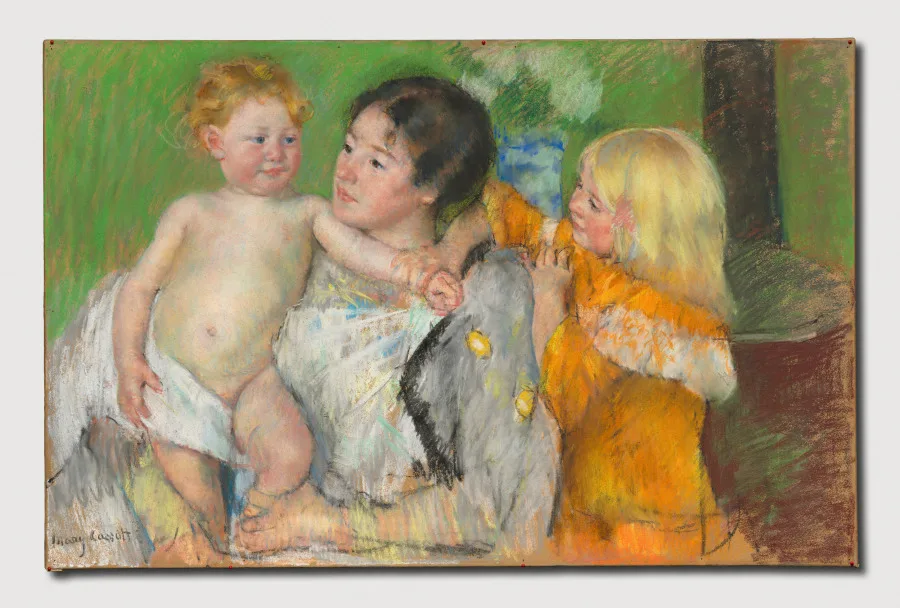
 America, late 18th-19th Century · 1901
After the Bath
Mary Cassatt (American, 1844–1926)
pastel
Both images establish care through bodily contact, but they belong to different subjects, materials, and histories of making. Begin with visible support, then ask what the museum’s identification adds beyond a familiar mother-and-child arrangement.
America, late 18th-19th Century · 1901Mary Cassatt (American, 1844–1926)
pastel
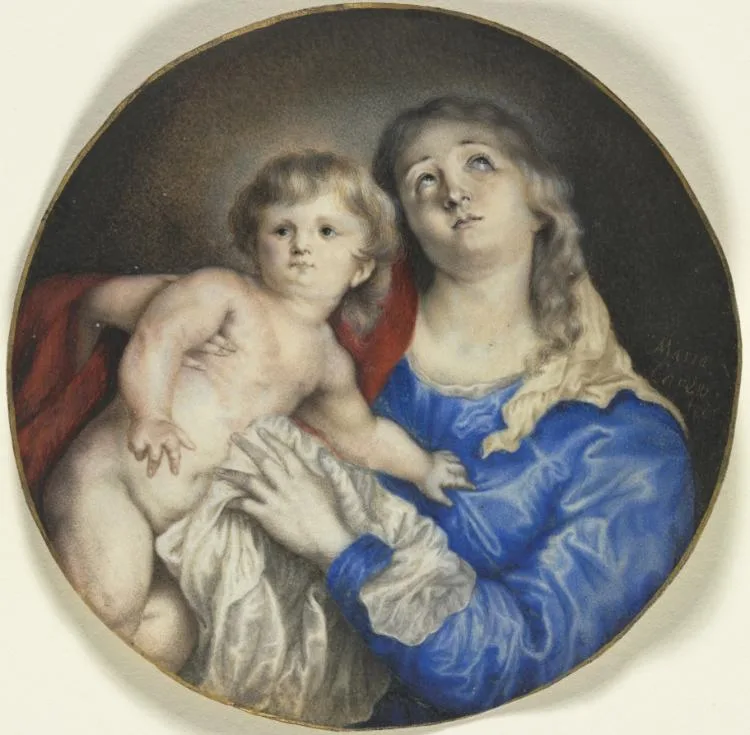 England, 17th century · c. 1662
Anna Maria Carew (British); after Anthony van Dyck (Flemish, 1599–1641)
watercolor heightened with gum on vellum, with gold
Cassatt’s child rests against an adult’s supporting body, with an arm crossing her chest. Carew places hands and gathered cloth near the center of the circular miniature. Contact gives each group a physical coherence before we attach everyday or devotional meanings to it.
Cassatt includes a fair-haired third figure leaning inward, whose identity the supplied description leaves unspecified. Carew’s Mary looks upward while the child turns sideways. Different gazes complicate each compact group without licensing invented names, relationships, or private thoughts.
Cassatt’s loose pastel marks remain visible across cloth. Carew’s narrow circular boundary encloses a miniature only about twelve centimetres across, made after a larger Van Dyck composition. A screen can make them look similar in size while obscuring very different original experiences.
Shared bodily contact does not make the subjects interchangeable. Carew’s devotional miniature has an acknowledged source composition; Cassatt’s everyday scene includes an unnamed third participant whose relationship remains open.
The comparison of visible choices is our own reading. Follow either artwork page for its full context, uncertainty note and image-rights record.
Five encounters organised by looking, making and care.
Holding, crowning, sewing and waiting connect bodies to larger narratives.