Small actions, sacred stories
A religious image may concentrate on a quiet action rather than a dramatic climax. These five works make touch, service, interrupted work and reflection carry larger Christian narratives. Begin with the visible relationship between bodies and objects, then consult the specific story. Shared gestures can support different readings and belong to different kinds of devotional object.
Begin the journey ↓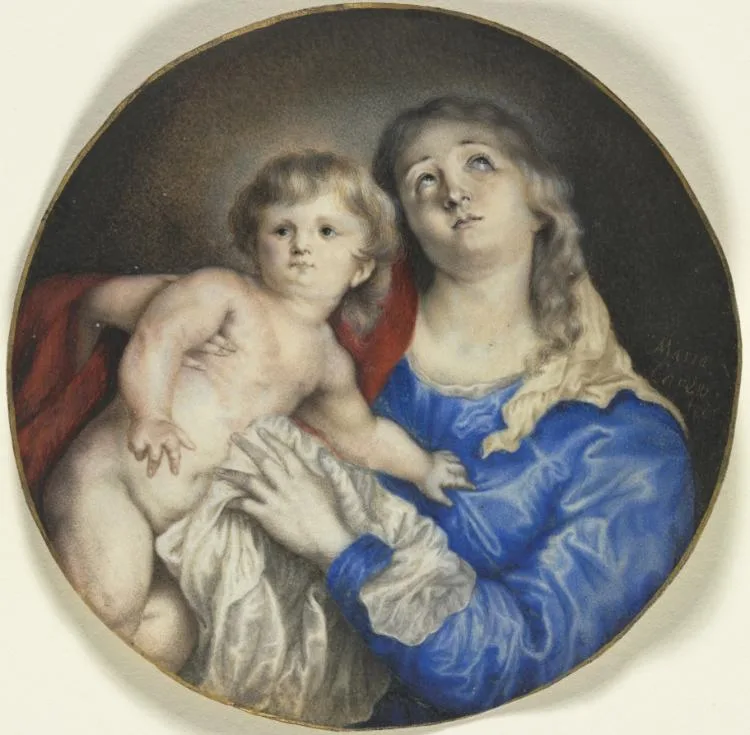
Holding within a small circle
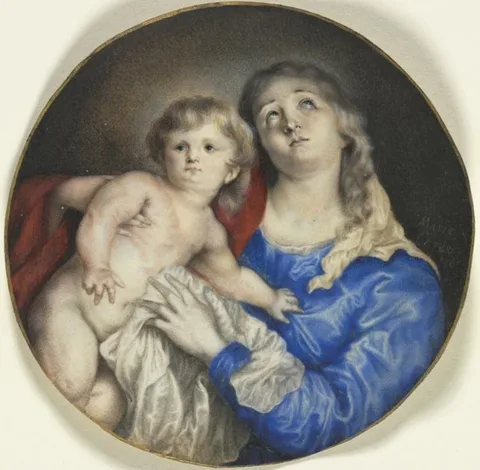
Hands gather the child and cloth within a miniature’s close frame. Carew works after a Van Dyck composition, changing the encounter through scale and format. Enlargement makes details accessible but can hide the original object’s intimate size.
Carry this question: How does the circular boundary concentrate the act of holding?
Open the artwork ↗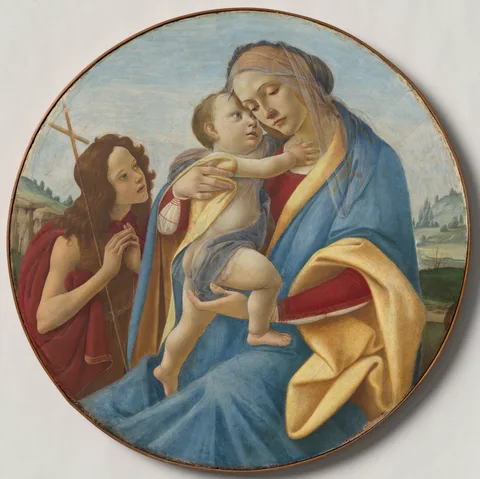
A small cross identifies a participant
The young John’s cross supplies a specific identifying clue within the circular group. His pose joins the other figures rather than opening a separate episode. Retain the collaborative Botticelli and Workshop attribution when reading the work as a whole.
Carry this question: How does the small figure help complete the circle?
Open the artwork ↗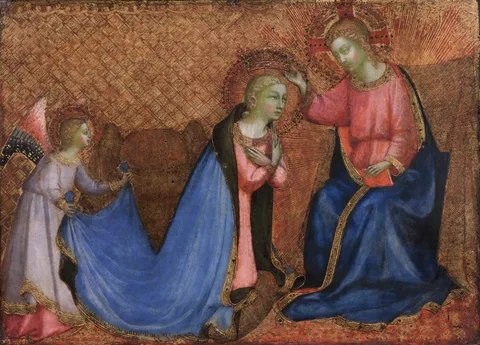
An attendant extends the ceremony
The small angel handling the train gives a secondary action a clear role in the crowning scene. It helps explain a broad sweep of blue cloth. The panel’s original function remains unsettled despite its rich gold surface.
Carry this question: What becomes clearer when you notice who handles the train?
Open the artwork ↗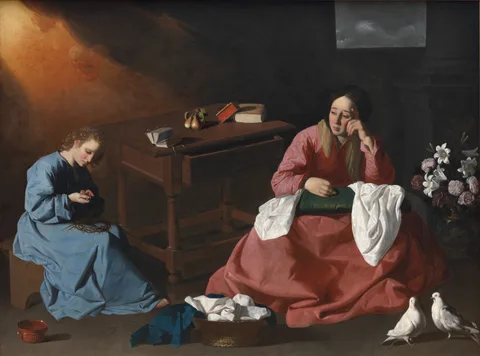
A small injury points forward
The thorn crown makes a domestic moment anticipate Christ’s later suffering. The museum treats this episode as apparently invented by the painter, so its narrative force should not be confused with a directly illustrated biblical passage.
Carry this question: How does the small object change the quiet household setting?
Open the artwork ↗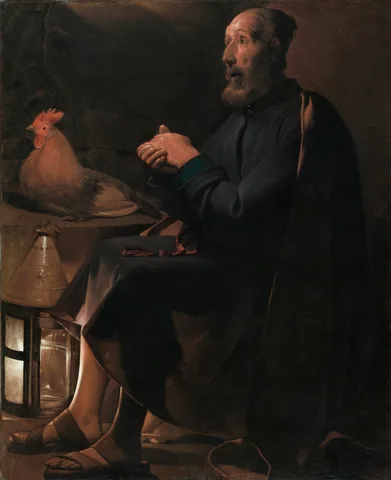
An animal recalls an earlier event
The rooster supplies a connection to Peter’s denial, while the man’s posture concentrates on repentance afterward. A familiar bird becomes an attribute within this specific story; it would not identify every nearby figure as Peter.
Carry this question: What does the rooster add that the seated pose alone cannot tell you?
Open the artwork ↗Look at a pair more closely
- What holding makes visible
Cassatt’s After the Bath and Carew’s Virgin and Child
- What darkness lets us see
La Tour’s Peter and Rembrandt’s Three Crosses
Read with the sources
Historical context follows the individual museum records linked on each artwork page. These routes make original comparisons of visible form; resemblance alone is not evidence of shared meaning or direct influence.