 Egypt, Greco-Roman period (332 BCE–395 CE), Ptolemaic dynasty (305–30 BCE) · 100–1 BCE
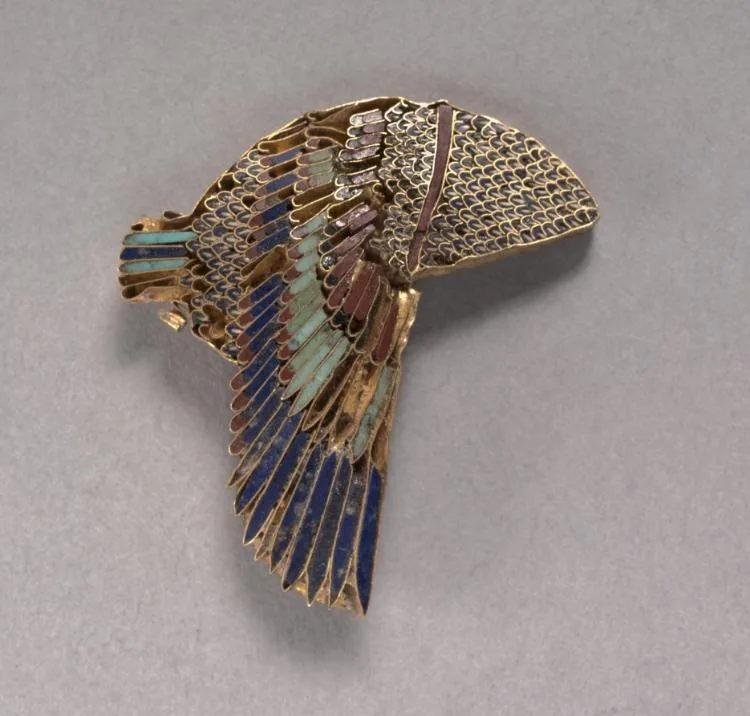
Vulture Headdress Inlay
Maker unrecorded
gold and semi-precious stones
Both objects construct images through the careful fitting of differently coloured materials. Compare the boundary between pieces, the scale of individual units and the support beneath them. Their present colours also carry histories of material change, so the photograph cannot be assumed to reproduce the original effect.
Egypt, Greco-Roman period (332 BCE–395 CE), Ptolemaic dynasty (305–30 BCE) · 100–1 BCEMaker unrecorded
gold and semi-precious stones
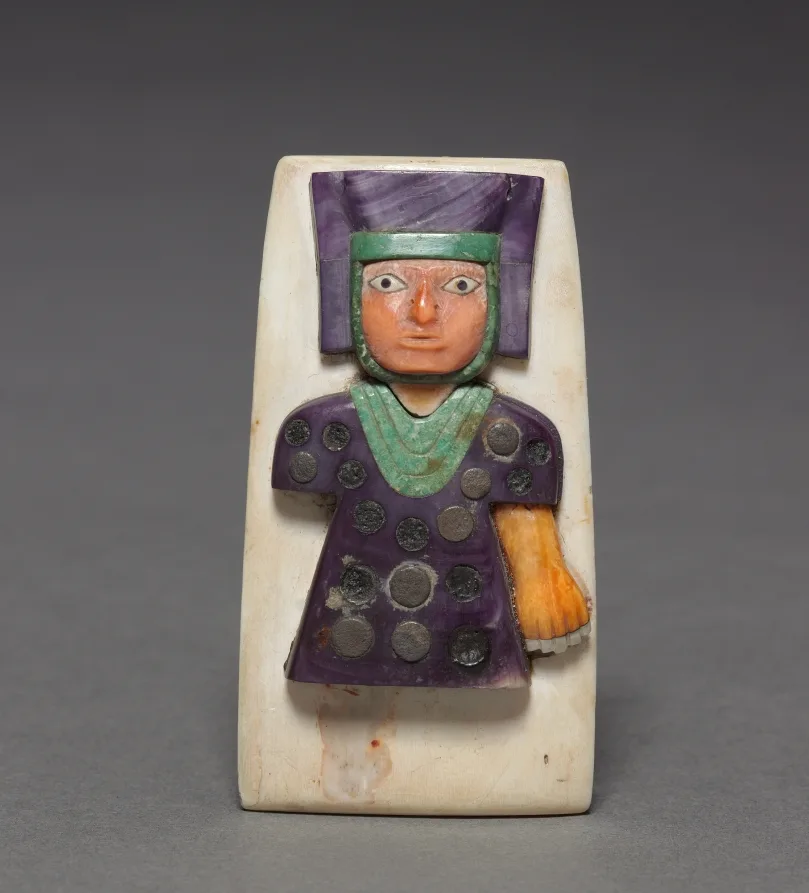 Central Andes, Wari style · 600–1000
Maker unrecorded
shell, stone, and metal (silver?)
Long blue elements become feathers in the Egyptian inlay. Separate shell and stone elements become a face, framing ornaments and headdress in the Wari work. The joins are structural facts as well as lines within each image; neither design was painted on a single continuous coloured surface.
Many tiny compartments fill the vulture’s upper feather area. Dark circular inserts repeat across the Wari tunic. Their scales and patterns organize the images differently, and the Wari spots were probably pyrite with a brighter original surface rather than an intended dark accent.
Gold partitions separate the Egyptian coloured inserts, with adhesive also documented in the record. A broad white-shell backing supports the Wari figure and remains visible around it. These features explain distinct construction systems without allowing every material to be identified confidently by colour alone.
Visual similarity in fitted construction does not imply contact between these distant traditions. The surviving Egyptian element and Wari ornament also lack their complete original mounting contexts.
The comparison of visible choices is our own reading. Follow either artwork page for its full context, uncertainty note and image-rights record.
Four Egyptian objects make colour, reflection, carving and enclosure active.
Five American works make a person’s presence conspicuous.