Surfaces that do work
A surface can reflect a face, fit together coloured stones, carry an offering scene or surround a person with images. In these Egyptian examples, decoration is connected to an object’s purpose. Inspect the material operation first. Then ask how its appearance has changed through loss, corrosion, separation or display, and what the surviving record can actually support.
Begin the journey ↓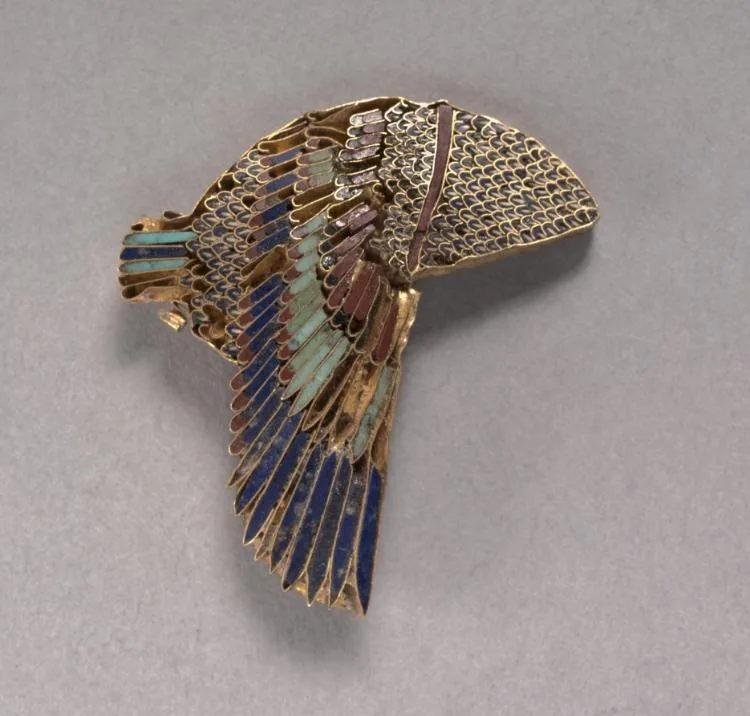
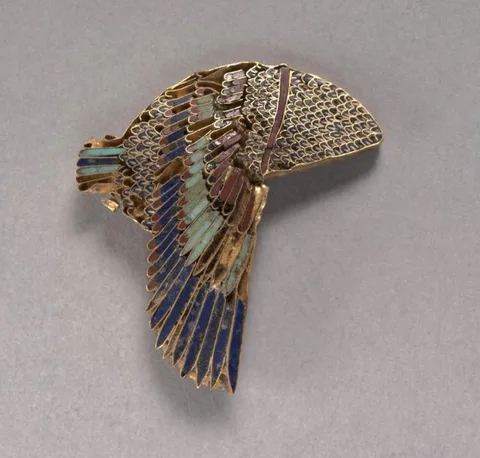
Feathers assembled from small pieces
Long feather forms are built from fitted coloured pieces separated by gold partitions. The museum identifies several materials and leaves some uncertain. This surviving headdress element makes close-fitting construction visible, while the complete original adornment must not be assumed from the fragment alone.
Carry this question: How do differently shaped compartments distinguish long feathers from the smaller patterned area?
Open the artwork ↗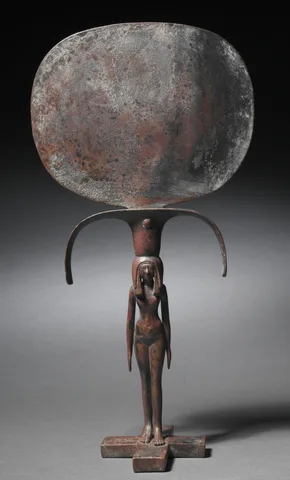
A dark disk once reflected light
The broad bronze disk now carries a mottled surface. It was once polished to serve as a mirror, supported above a papyrus form and a female figure. Its current colour and texture reveal a changed material state, not the reflection an earlier user would have encountered.
Carry this question: What would have to change about the surface for you to see yourself in it?
Open the artwork ↗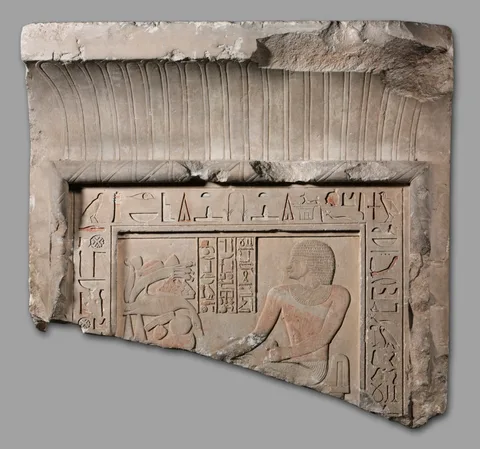
An offering represented in stone
An arrangement of offerings faces the seated Shemai. The museum connects the scene and text with provision for his ka, while identifying him as a chief of police. The panel’s broken lower edge limits what remains visible of the complete scene.
Carry this question: How does the offering arrangement direct attention toward the seated person?
Open the artwork ↗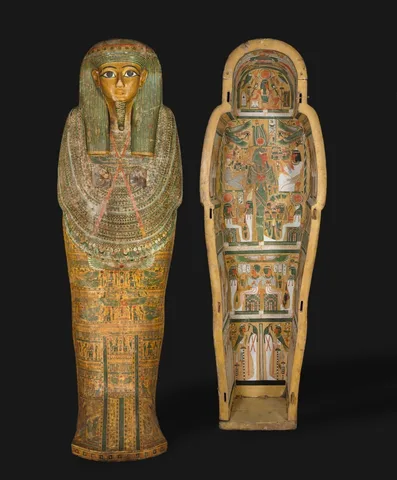
Images continue on the inside
The photograph places the painted lid beside the open coffin body. Figures and signs occupy the interior as well as the outside. This was part of a nested funerary arrangement; the photograph makes two surfaces simultaneously visible that were meant to operate in a different spatial relationship.
Carry this question: How does opening the coffin change the way its images can be seen?
Open the artwork ↗Look at a pair more closely
- Bodies below mirrors
An Egyptian caryatid and a Greek athlete turn figures into supports.
- Images from fitted pieces
An Egyptian vulture element and a Wari figure make assembly visible.
- Giving in two images
A Teotihuacan mural and an Egyptian stele represent provision differently.
Read with the sources
Historical context follows the individual museum records linked on each artwork page. These routes make original comparisons of visible form; resemblance alone is not evidence of shared meaning or direct influence.