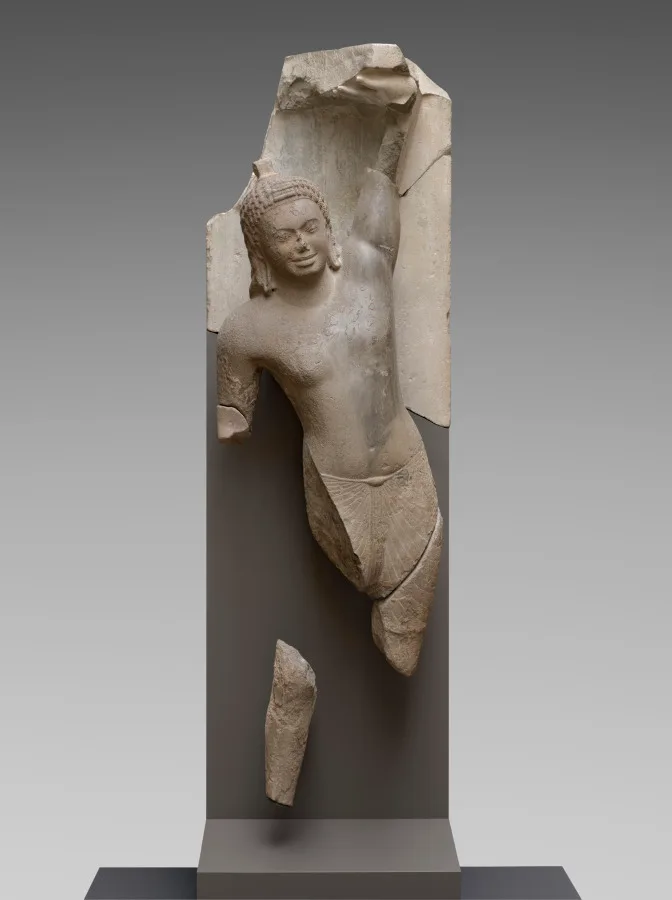
 Southern Cambodia, Takeo Province, Phnom Da · c. 600
Krishna Lifting Mount Govardhan
Maker unrecorded
Sandstone
Both works are identified with Krishna lifting Mount Govardhan, but they distribute the narrative differently. Compare a surviving bodily action in stone with a painted crowd, storm, and shelter, without overlooking the sculpture’s damage.
Southern Cambodia, Takeo Province, Phnom Da · c. 600Maker unrecorded
Sandstone
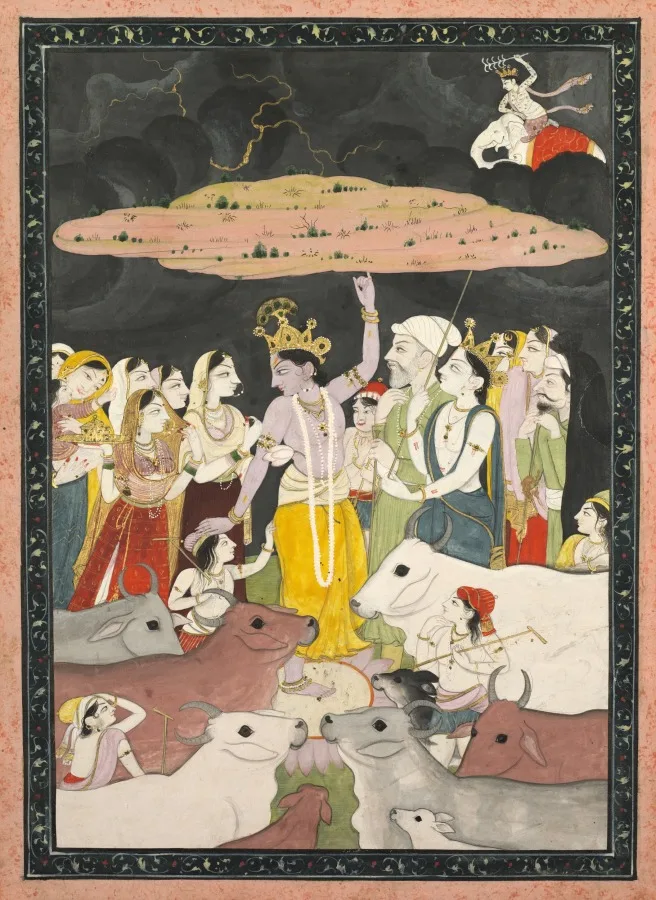 Northern India, Himachal Pradesh, Pahari Kingdom of Kangra · c. 1780–90
Maker unrecorded
gum tempera and gold on paper
The sculpture preserves a raised arm and leaning torso, while the painting makes the mountain rest on a small finger. Each concentrates extraordinary action in a physical gesture suited to its medium.
The sculpture centres on the divine body. The painting places villagers and cattle beneath the mountain, showing whom the action protects. Narrative detail can be carried by surrounding figures rather than by the hero alone.
A detached stone fragment and modern support belong to the sculpture’s present display. Indra in the painted sky belongs to the narrative. These different kinds of information should not be treated as equivalent scene elements.
The works come from different regions and periods. Their shared narrative identification does not imply direct copying, an identical original setting, or a complete reconstruction of the damaged sculpture.
The comparison of visible choices is our own reading. Follow either artwork page for its full context, uncertainty note and image-rights record.
Narratives organise danger in different ways.