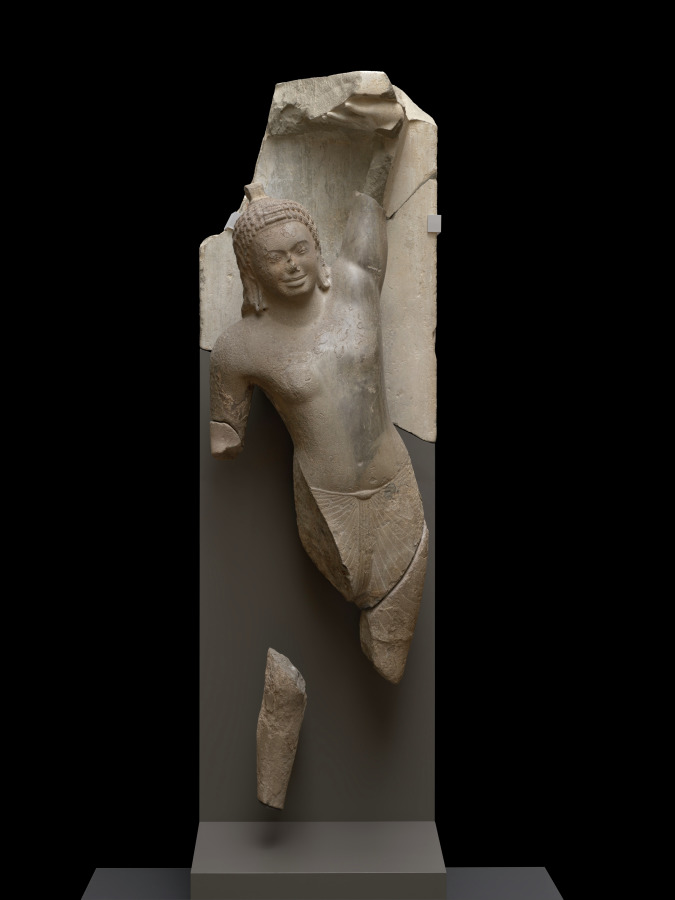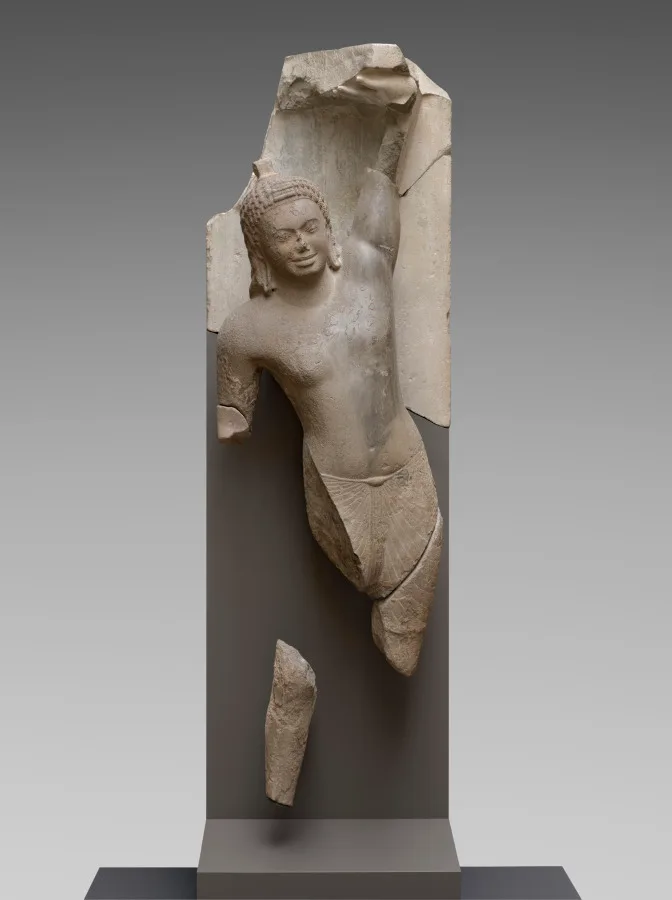
A raised arm and leaning torso preserve a protective action, while the gaps in the stone keep the sculpture’s survival in view.
The raised arm is the key surviving action. The body leans beneath it, while a mass of stone above suggests the burden that the museum identifies as Mount Govardhan. Krishna holds the mountain to protect villagers and cattle from a violent storm. In the present fragmentary state, however, the full supporting arm, lower body, and surrounding form cannot all be read as an intact original.
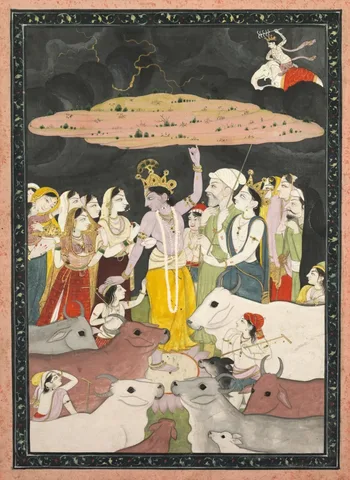
The museum places the sculpture at Phnom Da in southern Cambodia and relates it to a group of monumental figures recovered near the ancient centre of Angkor Borei. Holes in the ears once held gold earrings, adding another material to the sandstone body. Compare the later Kangra painting of the same story: the painting includes a crowd, cattle, storm, and Indra, while the sculpture concentrates the narrative in one bodily action. Its display also tells a separate story of survival, with a detached fragment and modern support clearly different from the ancient carving.
The sculpture is fragmentary, and the modern support is not part of the ancient work. The museum identifies the mountain-lifting narrative; missing stone should not be filled with invented details about a complete original pose.