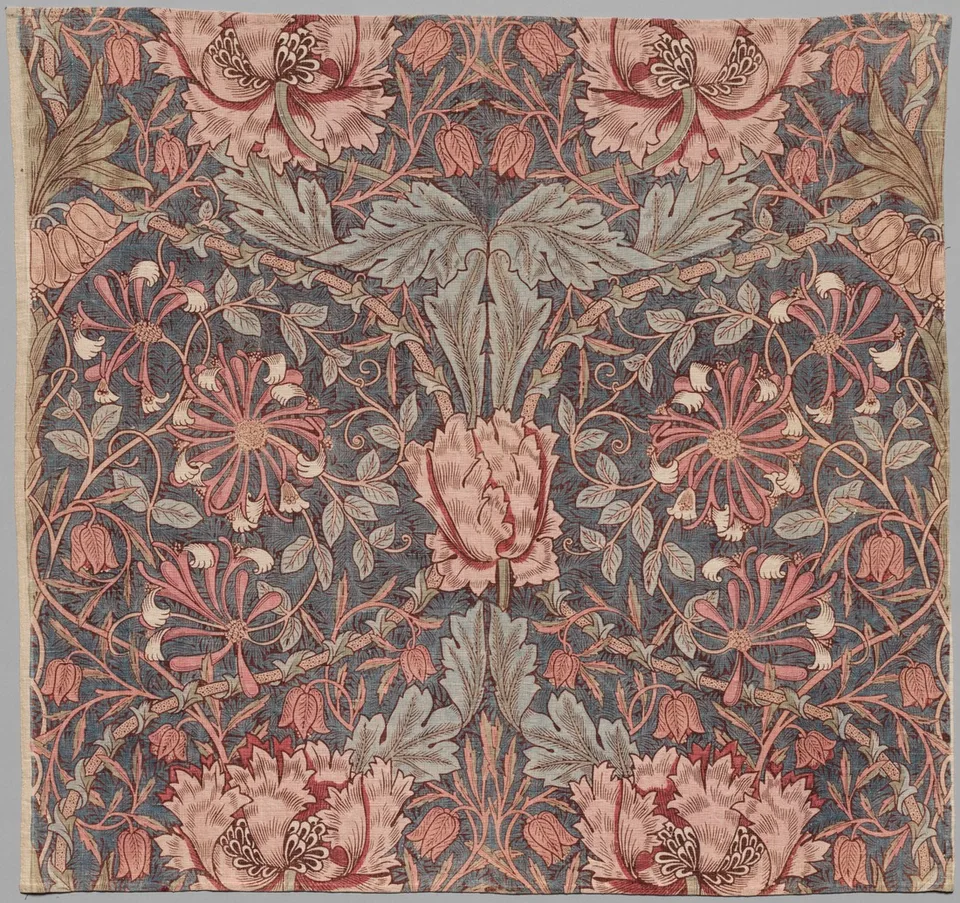
 England, Early 20th century · Early 20th century
Honeysuckle
William Morris (British, 1834–1896) (designer)
plain weave linen, printed
A dense printed textile and a restrained stained-glass panel both organize leaves through repetition. Compare mirroring, framing, and color while keeping an interior design theory separate from a cautiously proposed monastic context.
England, Early 20th century · Early 20th centuryWilliam Morris (British, 1834–1896) (designer)
plain weave linen, printed
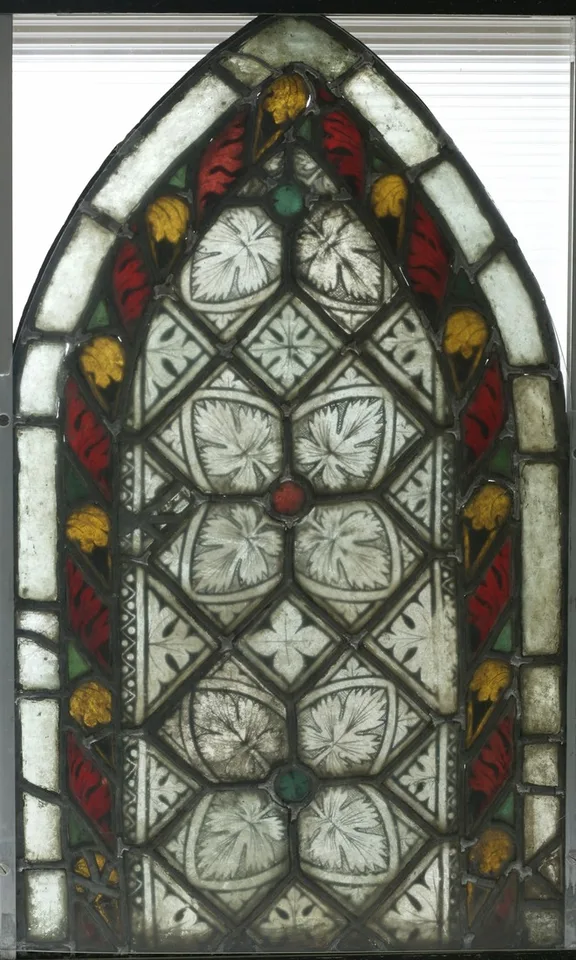 France, Alsace(?), 13th century · c. 1275–1300
Maker unrecorded
pot-metal and white glass, silver stain
The textile’s paired central leaves reveal a mirror axis within a tangled field. The window encloses repeated pale leaves in geometric compartments. Both organize natural forms, but one encourages flowing continuation while the other emphasizes discrete framed units.
Pink open flowers spread across the linen among larger blooms. In the glass, stronger color concentrates along the border around a pale center. The comparison shows that decorative richness can come from saturation throughout or from carefully limited accents.
The textile cuts a blossom at its lower edge, implying another repeat beyond the fragment. The glass’s dark divisions hold separate pieces within an architectural whole. An edge can suggest continuation in one medium and necessary construction in another.
Morris’s ideas about restful large patterns do not explain medieval glass. The window’s proposed Cistercian origin remains unconfirmed, and the textile’s present printing postdates its designer.
The comparison of visible choices is our own reading. Follow either artwork page for its full context, uncertainty note and image-rights record.
Cut paper, printed linen, glass, horn, and tapestry.