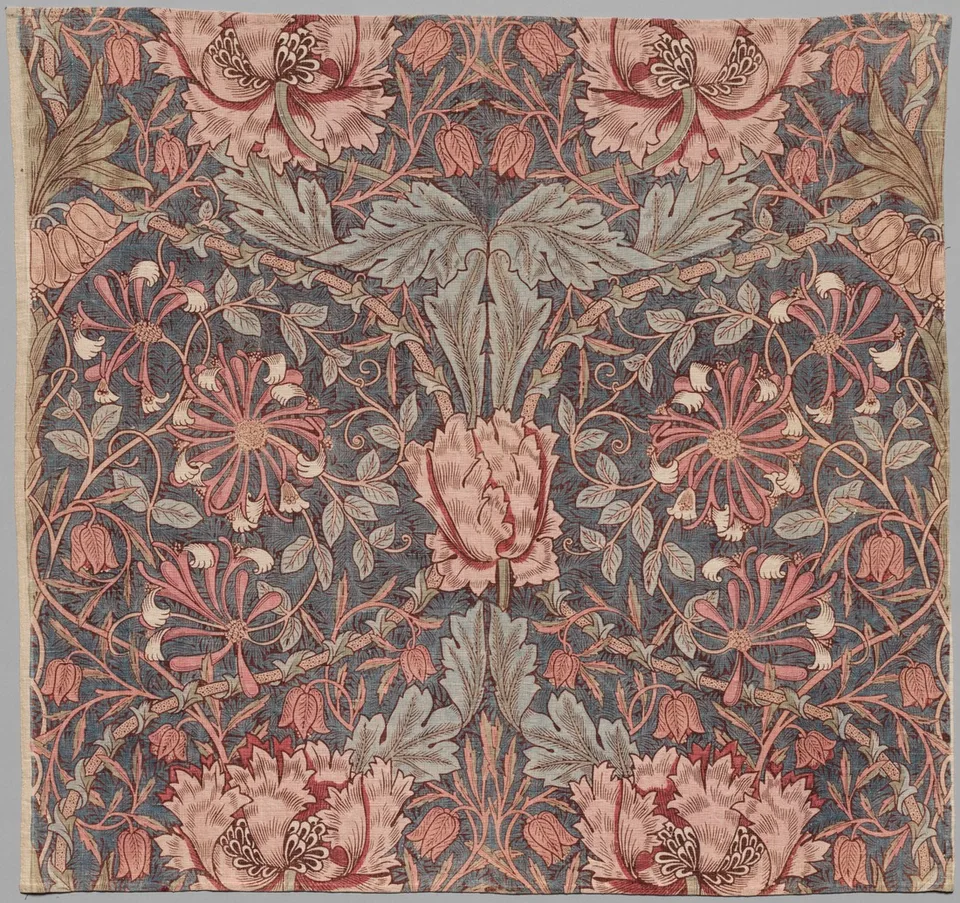
A tangle of flowers becomes orderly when you find the mirrored stems on either side of its center.
The surface first looks exuberantly tangled. Large blossoms overlap leaves, and slender stems curl between smaller flowers in many directions. Yet the middle offers a key: paired leaves and related side blooms reflect one another around a vertical axis. Once that structure becomes visible, the complexity feels less random, and the eye can move between individual flowers and the larger repeat.
The museum describes Honeysuckle as an unusually broad mirrored pattern, nearly spanning a loom’s width. Morris believed large patterns could be restful even in small rooms, a view that challenges the assumption that modest spaces always require tiny ornament. This particular printed linen dates to the early twentieth century, after the designer’s lifetime. It preserves an earlier design’s relationship to English garden plants while also reminding us that a design and its later material production have separate dates. The cut motifs at the edges invite us to imagine repeated lengths rather than a self-contained picture.
The displayed fragment cannot reproduce the experience of a whole furnished room. Its early twentieth-century manufacture must also be distinguished from Morris’s earlier design activity.