Plants become surfaces
Plants can be studied, remembered, repeated, or translated into useful objects. These six works make that translation visible through very different materials. Follow contour, symmetry, transparency, and the boundary between a motif and its support. Shared leaves do not guarantee shared meanings, and later backing or replaced heraldry can change what a botanical surface currently appears to say.
Begin the journey ↓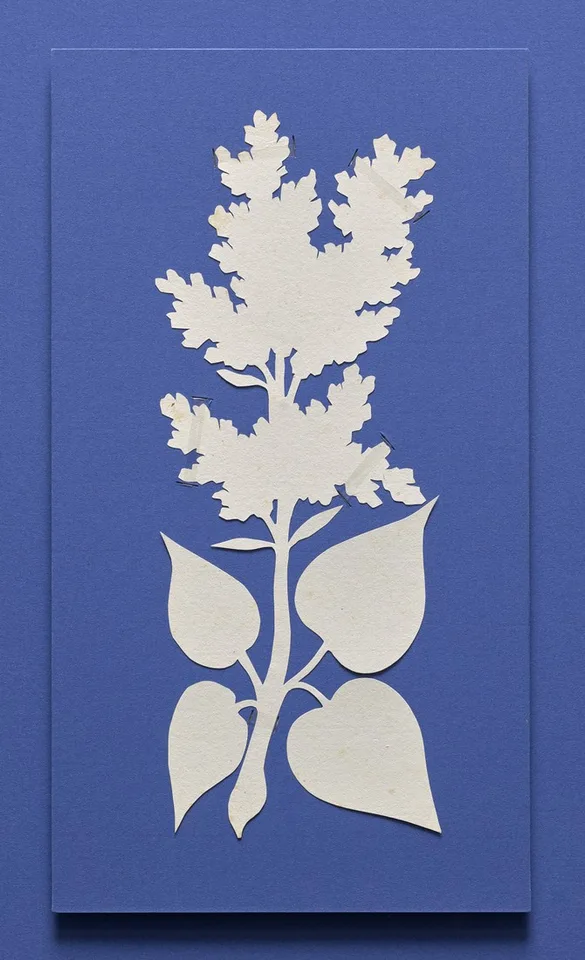
Plain heart-shaped leaves
A plain leaf needs only its cut contour to become recognizable. The modern blue backing sharpens the present contrast but should not be assumed original to Runge’s gift.
Carry this question: What information does the unmarked leaf still convey?
Open the artwork ↗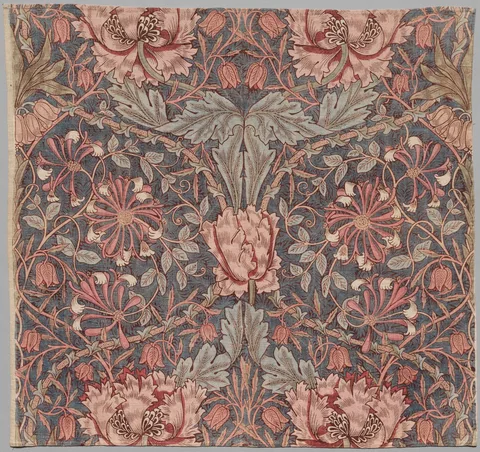
The central mirrored leaves
A central pair of leaves reveals the mirror structure within a dense printed tangle. Finding the axis lets ornament remain elaborate without seeming arbitrary.
Carry this question: Which other forms balance across the same axis?
Open the artwork ↗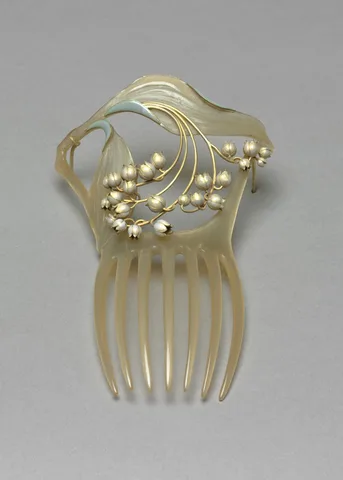
Long curved teeth
The plant’s curves continue into functional comb teeth. Horn leaves, enamel flowers, and gold stems make the ornament’s material differences part of its botanical effect.
Carry this question: Where does practical structure become decorative growth?
Open the artwork ↗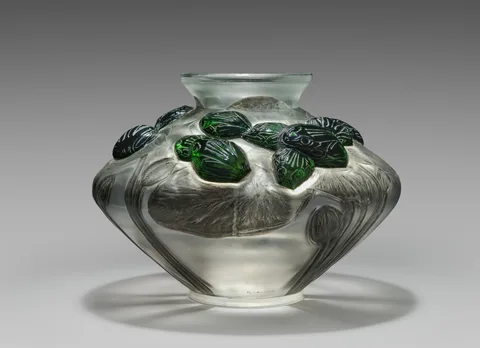
Broad lily pads
Lily pads now occupy a glass shoulder beneath green frogs. Relief and changing transparency evoke a habitat through material behavior as well as recognizable motifs.
Carry this question: How does the glass suggest both solid forms and water?
Open the artwork ↗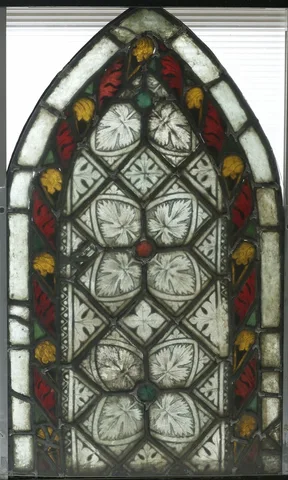
The colored border
A restrained leaf field is edged with strong color. The contrast matters when considering the museum’s tentative Cistercian connection, which is not a secure origin.
Carry this question: What would be lost by calling the whole window monochrome?
Open the artwork ↗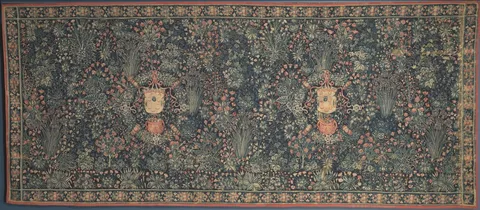
The left heraldic display
Flowers surround heraldry added in place of earlier arms. A rich plant field need not have a complete symbolic code, and the current shield need not name the original patron.
Carry this question: Which visible feature belongs to a later intervention?
Open the artwork ↗Look at a pair more closely
- Leaves, pattern, and restraint
Morris’s Honeysuckle and medieval aconite glass
- Plants cut and studied
Runge’s lilac silhouette and Merian’s moth sheet
Read with the sources
Historical context follows the individual museum records linked on each artwork page. These routes make original comparisons of visible form; resemblance alone is not evidence of shared meaning or direct influence.
- Lilac — museum collection record
- Honeysuckle — museum collection record
- Lily of the Valley Comb — museum collection record
- Frogs and Lily Pads (Grenouilles et Nénuphars) Vase — museum collection record
- Stained Glass Panel with Aconite Leaves — museum collection record
- Millefleurs Tapestry with Medici Coat of Arms — museum collection record