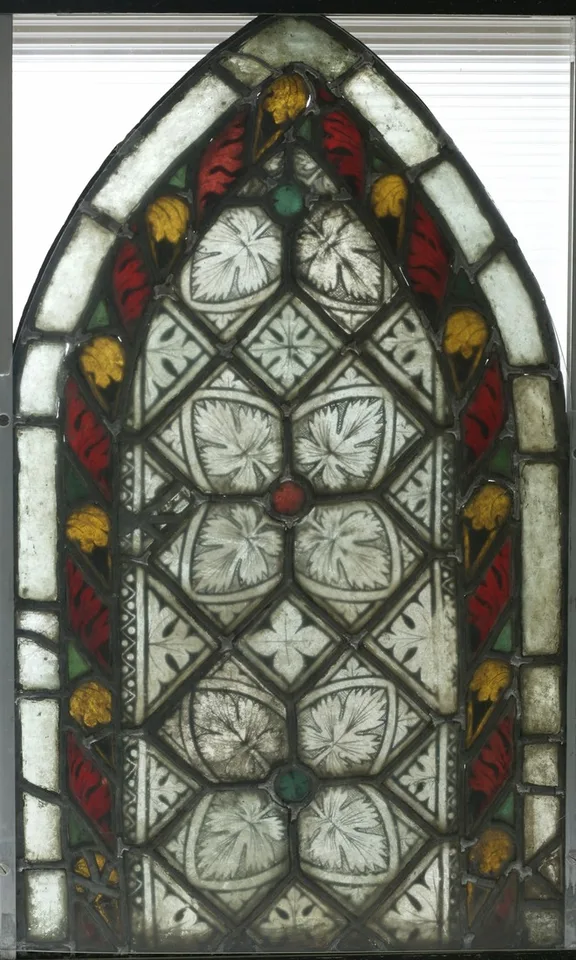
Pale leaves dominate the window, but its narrow colored border prevents monochrome restraint from meaning a complete absence of color.
The center is organized by repeated leaf forms, each enclosed within a dark geometric frame. Painted veins spread across the pale glass, making the pattern legible without brilliant color. Around that restrained center, red and yellow accents create a narrow but persistent rhythm. The pointed arch gathers these repetitions into an architectural shape rather than a continuous textile-like field.
The museum describes the central technique as grisaille and tentatively connects the window with a Cistercian church. The order’s restrictions on figural imagery and brightly colored glass make that possibility plausible, but the panel’s original source is unknown. Its restrained decoration therefore supports a hypothesis without proving institutional origin. The colored border is also essential evidence: the object is not uniformly monochrome. Comparing center and edge lets us see how visual richness could be distributed through painted line, repeated leaves, small colored passages, and the physical network that holds the glass together.
The Cistercian connection is a suggestion based on decorative restraint; the original church is unknown. The panel’s colored border also complicates any description of it as wholly monochrome.
What qualifies a description of this as monochrome glass?
Practise looking at Stained Glass Panel with Aconite Leaves →