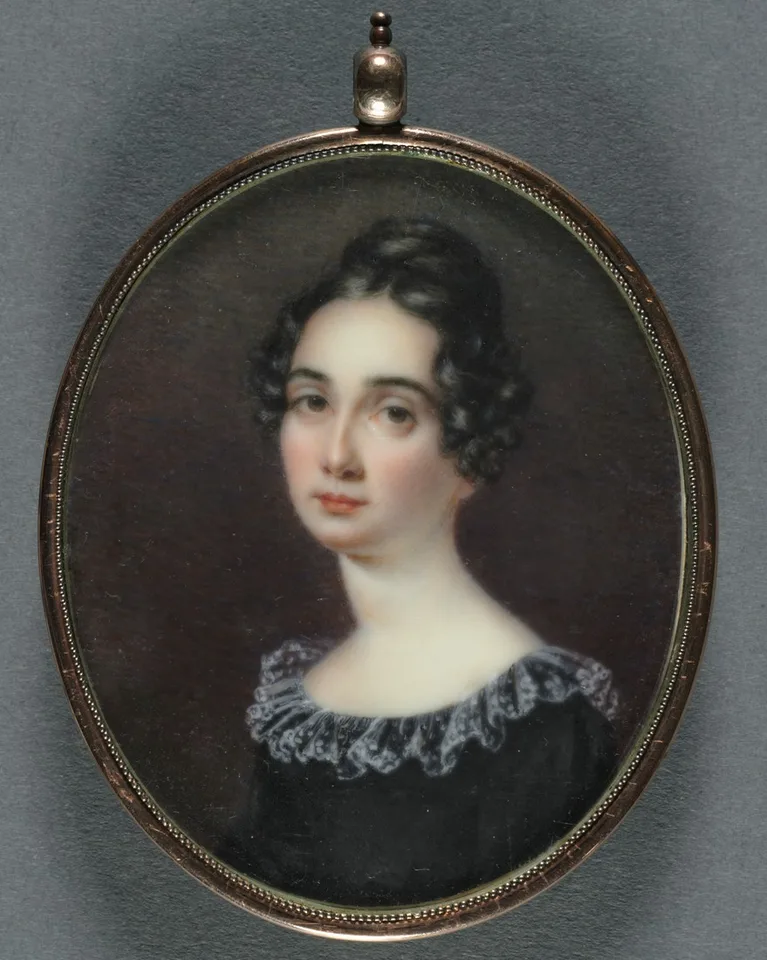
 United States · 1820
Portrait of a Woman
Anna Claypoole Peale (American, 1791–1878)
watercolor on ivory on a gilt metal locket with red leather case
Both women painted intimate oval likenesses, yet the sitter's edges look different. Peale's dark clothing meets a lace neckline; in Baker's portrait, shoulders merge with the pale ivorine support. Their frames reveal shared portability while the materials and unidentified sitters preserve important differences.
United States · 1820Anna Claypoole Peale (American, 1791–1878)
watercolor on ivory on a gilt metal locket with red leather case
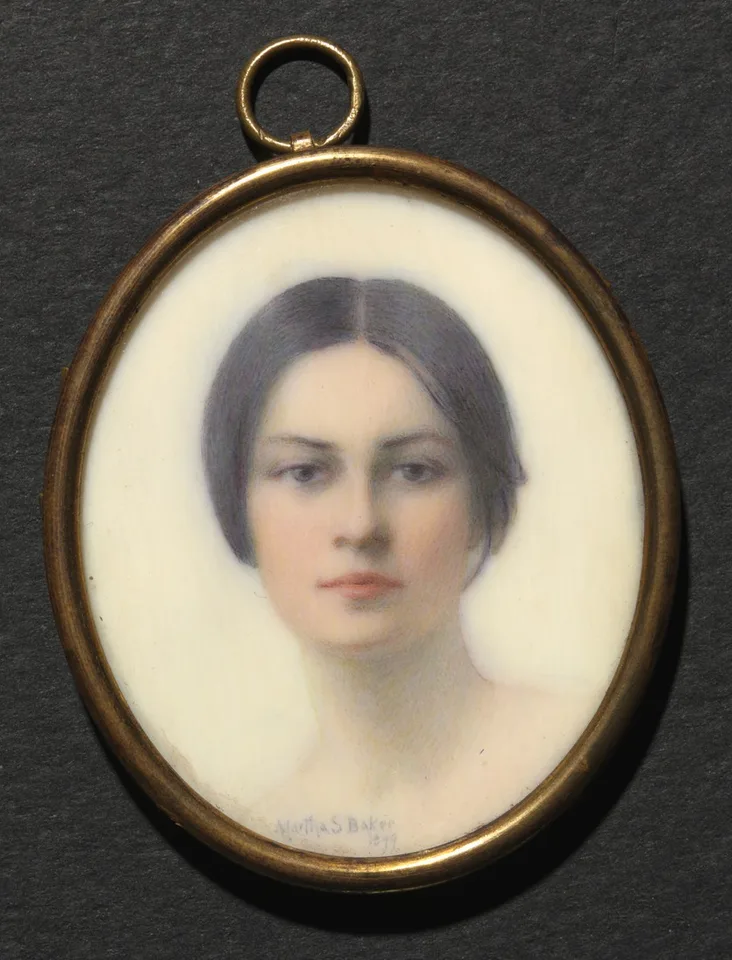 United States · 1899
Martha S. Baker (American, 1871–1911)
watercolor on ivorine
Peale warms pale skin with rosy cheeks and red lips against dark surroundings. Baker’s softer face leads downward into almost disappearing shoulders. Both focus attention on a person, but neither painting’s specificity restores the sitter’s missing name.
Peale’s pale lace gives the dark dress a crisp decorative boundary. Baker’s dark hair supplies the firmest boundary in a portrait that otherwise fades toward its support. Clothing and hair organize attention through different locations of contrast.
Peale’s locket fitting and Baker’s narrow oval frame make the portraits readable as small physical objects. Peale worked on ivory; Baker’s selected portrait uses ivorine. Similar presentation should not erase the distinction between those painting supports.
The sitters are unidentified, and their relationships or ownership histories differ in certainty. Portable format does not prove that both miniatures were exchanged as sentimental gifts.
The comparison of visible choices is our own reading. Follow either artwork page for its full context, uncertainty note and image-rights record.
From intimate miniatures to a figure designed for a skyline.