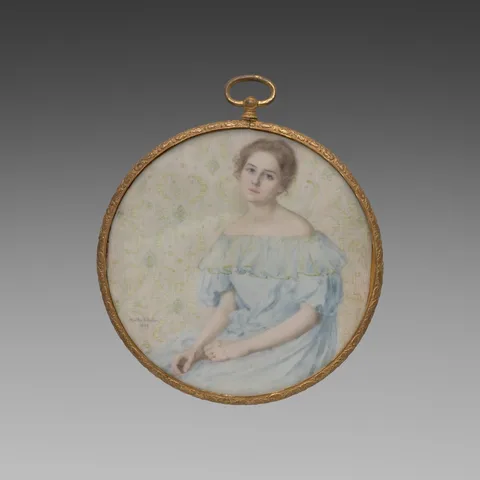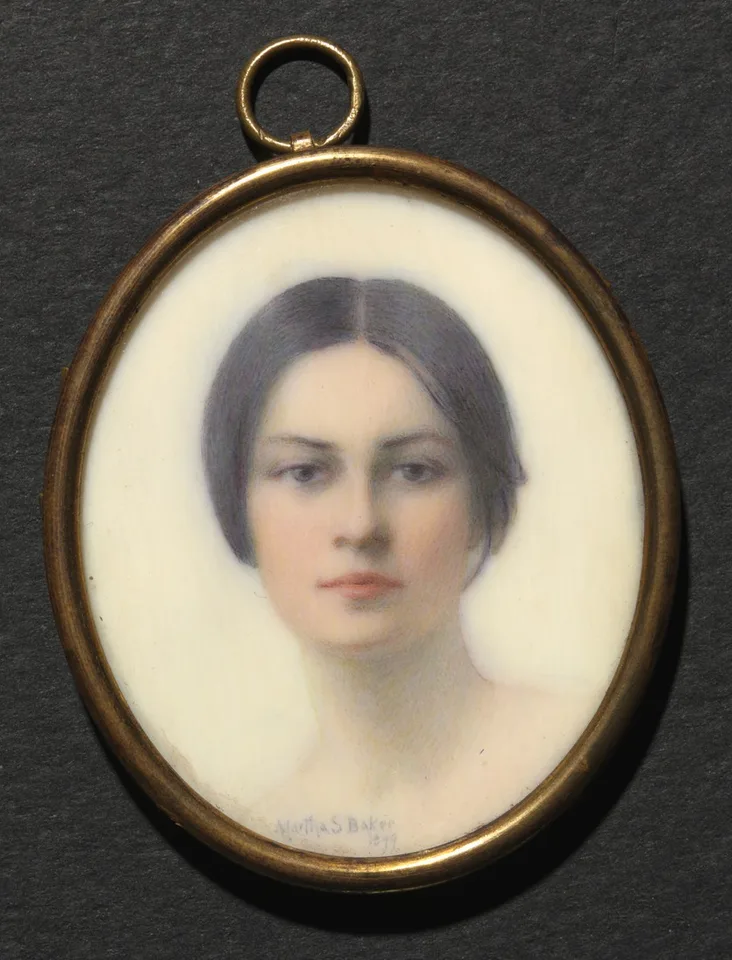
A sharply defined dark hairstyle gives way to nearly vanishing shoulders, making the miniature’s pale support part of the portrait’s effect.
Martha S. Baker painted this miniature while living and teaching in Paris in 1899. The sitter is unknown, although the museum thinks she was probably a student. Baker’s successful miniature practice eventually brought enough commissions that she left teaching. This work is painted on ivorine, an imitation-ivory support, a material distinction worth retaining when comparing it with Baker’s portraits on actual ivory.
The clearest boundary is the dark hair against the pale field. Within that frame, the face receives restrained shading and a direct, steady gaze. Below the chin, the shoulders become much less definite, almost merging with the support. The museum draws attention to this similarity between skin and painting surface. The result feels intimate without requiring elaborate costume or setting. The plain oval mount provides the final boundary that the painted shoulders themselves decline to supply, reminding us again that the image belongs to a small physical object.
The sitter's identity and student relationship are uncertain. The support is ivorine, not ivory; the softly fading shoulders alone do not establish whether Baker considered the work finished.