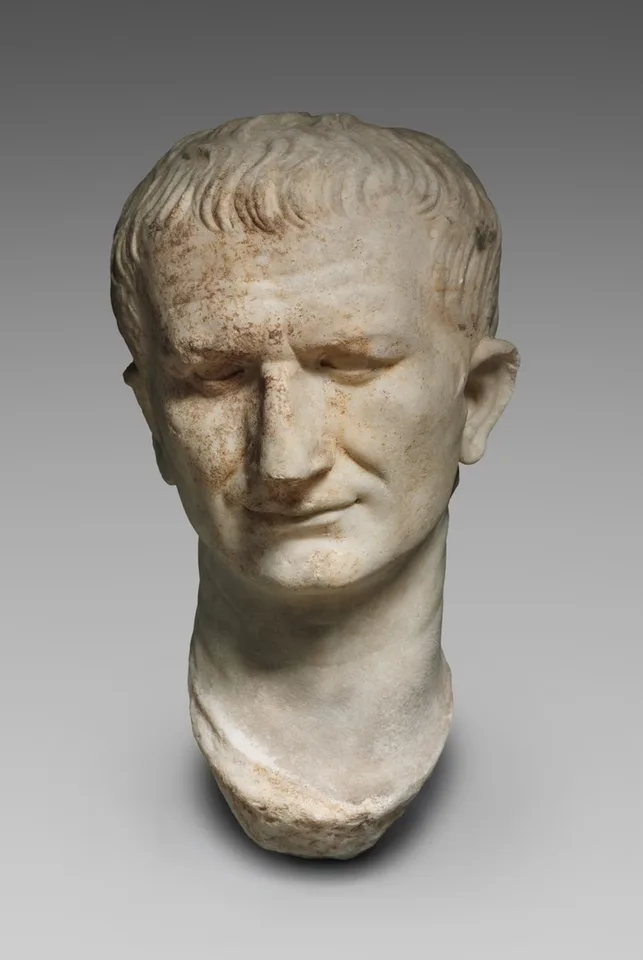
 Italy, Roman · 64–79 CE
Portrait Head of Emperor Vespasian, Recut from Head of Nero
Maker unrecorded
marble
Neither head survives as an untouched image from a single moment. Nero’s portrait was recut as Vespasian; a Herakles head was converted into a weight. Compare what remains recognizable with the alterations that changed identity or function, keeping ancient modification separate from modern display.
Italy, Roman · 64–79 CEMaker unrecorded
marble
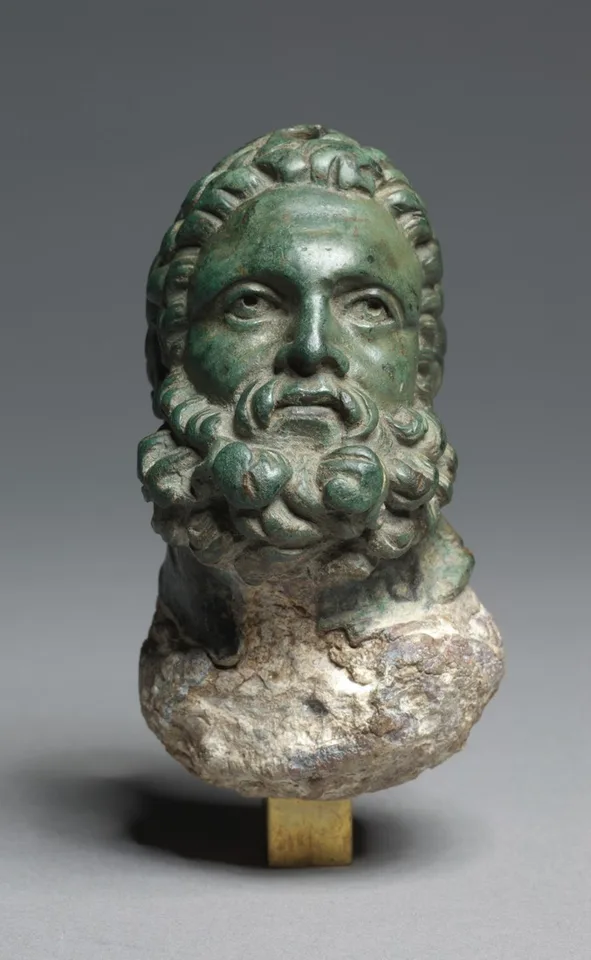 Greece, Hellenistic period · 300–200 BCE
Maker unrecorded
bronze filled with lead
Vespasian’s short forehead locks belong to a head whose longer Neronian hair was reduced. Herakles’s dense beard and short curls support the hero’s identification. Hair can preserve a revised portrait type or identify a mythic figure without supplying an individual biography.
The emperor’s receding lower lip is identified as a retained Neronian feature. Herakles’s upward gaze may connect with a known sculptural type. One comparison concerns a physical remnant of recutting; the other is a qualified relationship with a lost prototype.
The emperor’s rough neck was made for insertion into a statue, though his former museum body proved unrelated. The hero’s lower mass reflects lead filling and conversion into a weight. Both lower portions correct a reading focused only on the face.
Political recarving, practical reuse and later mistaken assembly are different processes. The objects do not document one shared attitude toward images or one sequence of alteration.
The comparison of visible choices is our own reading. Follow either artwork page for its full context, uncertainty note and image-rights record.
Animal vessels, an altered portrait, a roof tile and a reused bronze head.