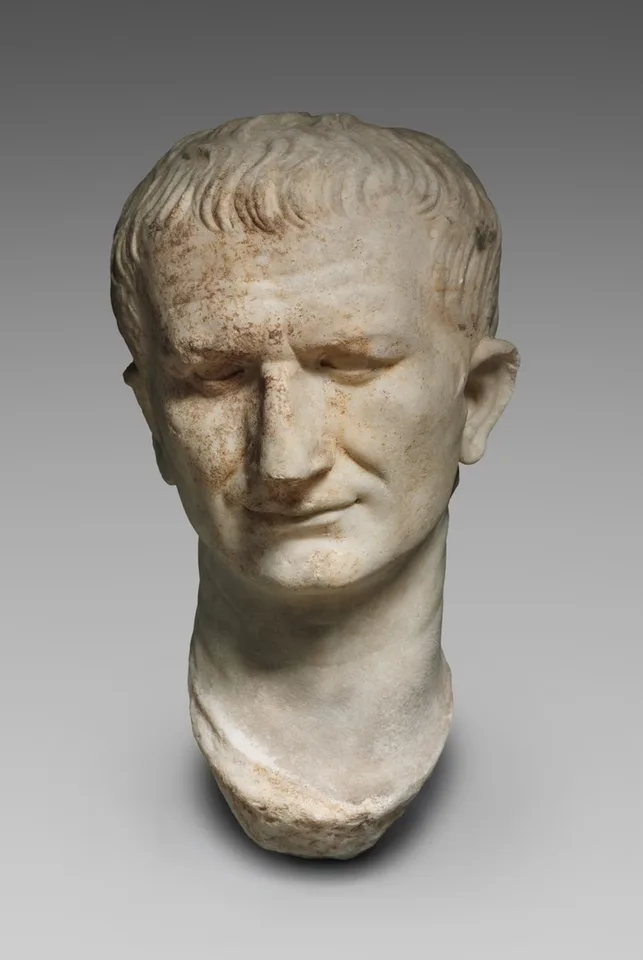
A Roman emperor’s face preserves traces of another ruler, turning a marble portrait into evidence of deliberate political revision.
The museum identifies this head as a portrait of Vespasian recarved from an earlier likeness of Nero. After Nero’s condemnation of memory, a sculptor changed the existing marble to represent a different emperor. The process did not erase every earlier feature. The museum notes a receding lower lip retained from Nero and a line at the back showing where longer hair was shortened. That back view is not visible in this photograph.
The frontal face therefore asks us to look for layered making rather than an untouched likeness. Short forehead locks, heavy brows and a compact mouth belong to a surface revised under political pressure. The head also has a modern collection history of mistaken assembly: it arrived attached to an unrelated togate body, from which it was separated in 1973. Its projecting lower neck was intended for insertion into a statue, but not that particular body. Both ancient recutting and later reassessment complicate the apparent completeness of a portrait head.
The clearest hair-recutting line is on the unseen back. The head’s former association with a different statue was corrected, so that body should not be used to reconstruct its original appearance.
Which visible feature shows that this head was intended to join another sculptural part?
Practise looking at Portrait Head of Emperor Vespasian, Recut from Head of Nero →