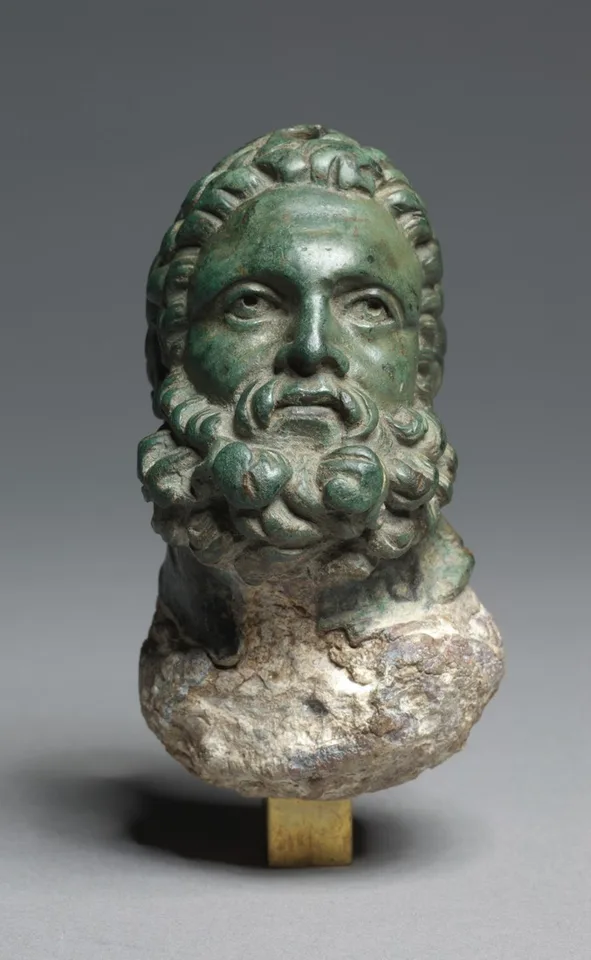
A hero’s uplifted face survives above a rough lead-filled base, showing how a small bronze image acquired a second practical life.
The museum identifies the head as Herakles through its short curly hair and full beard, even though his usual club and lion skin are absent. Its upward gaze may derive from a famous sculpture by Lysippos, the Herakles Epitrapezios, known through later versions. That proposed relationship places the small head within a history of copying and adaptation, but the original sculpture itself does not survive for direct comparison.
This object also underwent a more practical transformation. The bronze was filled with lead and fitted with holes for a hook, turning a sculpted head into a weight, probably during the Roman period. The rough mass beneath the face contrasts strongly with the carefully modeled curls. Those surfaces record different demands placed on the object: recognizable heroic features above, added weight and attachment below. The present photograph thus rewards looking beyond the face. Its altered material structure is as important as the identity of the person represented.
The connection to Lysippos is proposed, and the conversion to a weight is probably Roman rather than precisely dated. The eyes and mouth were likely once inlaid; their present appearance and the modern support do not reconstruct the original sculpture.
Which contrast most clearly signals the object’s altered practical life?
Practise looking at Head of Herakles Refashioned as a Weight →