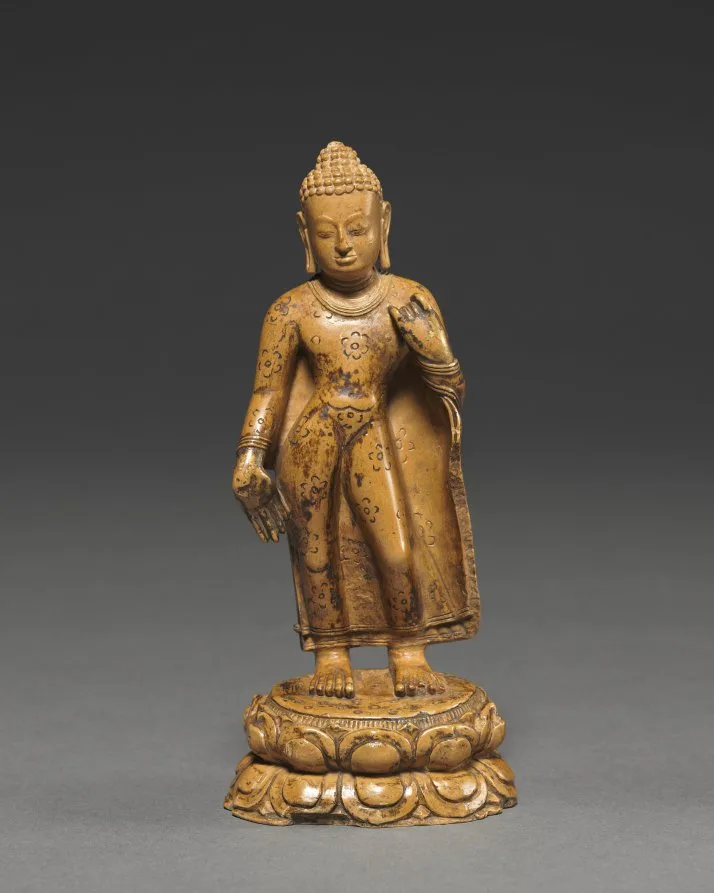
 Burma (Myanmar) · c. 800s
Standing Buddha
Maker unrecorded
Kaolin
A Buddhist sculpture from Myanmar and a Hindu bronze from Tamil Nadu organise the body in markedly different ways. Begin with balance, limbs and outline, then read their particular contexts separately. Visual comparison does not make these figures or traditions interchangeable.
Burma (Myanmar) · c. 800sMaker unrecorded
Kaolin
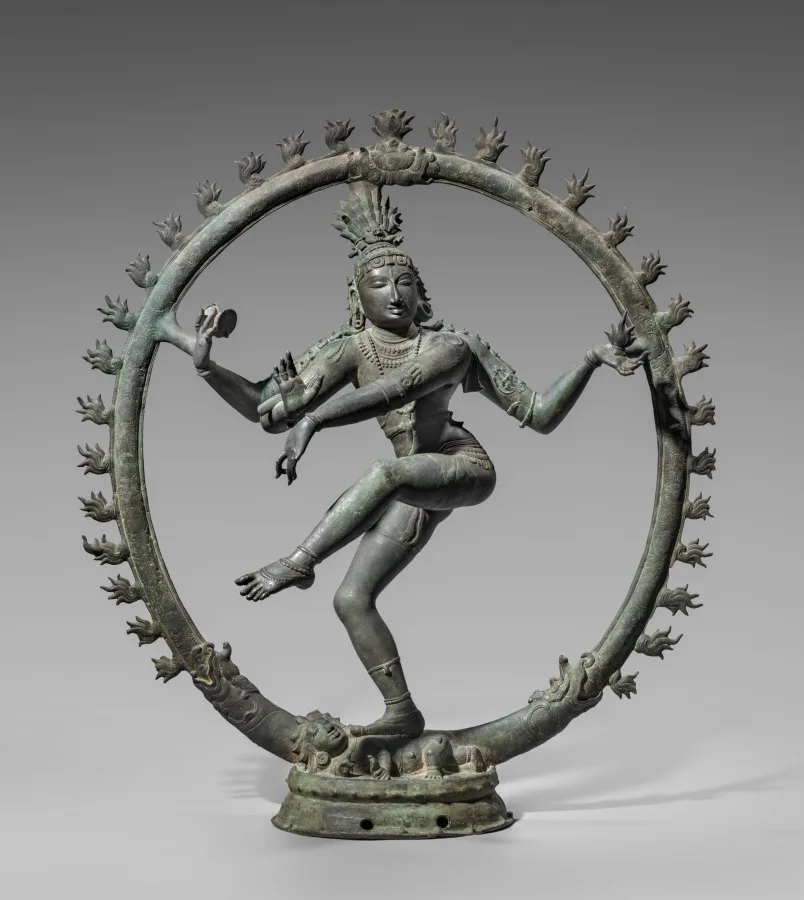 South India, Tamil Nadu, Chola period (900–1200s) · 1000s
Maker unrecorded
Bronze
The Buddha’s right arm descends close to the standing body with its palm facing outward. Shiva’s raised arm extends into the surrounding space and holds a drum. Compare those visible directions before using the respective Buddhist and Hindu contexts to explain them.
The Buddha stands on a double-lotus pedestal, while Shiva plants one foot on a small figure identified by the museum as ignorance. These supports participate in the subjects’ meanings as well as their silhouettes. The apparent balance in a photograph is not a test of either object’s actual centre of gravity.
The Buddha’s robe has flowers that may refer to his descent from heaven. Shiva’s lowered arm directs attention to a lifted foot, interpreted by the museum in terms of liberation through devotion. These readings depend on distinct religious narratives; similar bodily forms do not supply a shared meaning.
These objects belong to distinct religious contexts and periods. The comparison concerns formal choices and reading methods, not a claim that they share a theology.
The comparison of visible choices is our own reading. Follow either artwork page for its full context, uncertainty note and image-rights record.
A gesture is a clue, not a universal language.