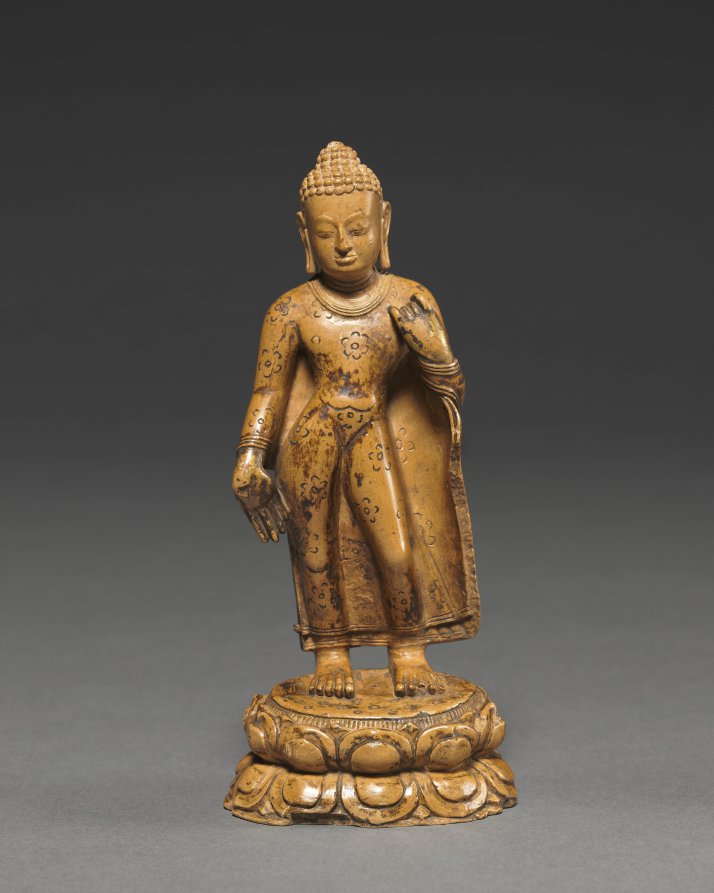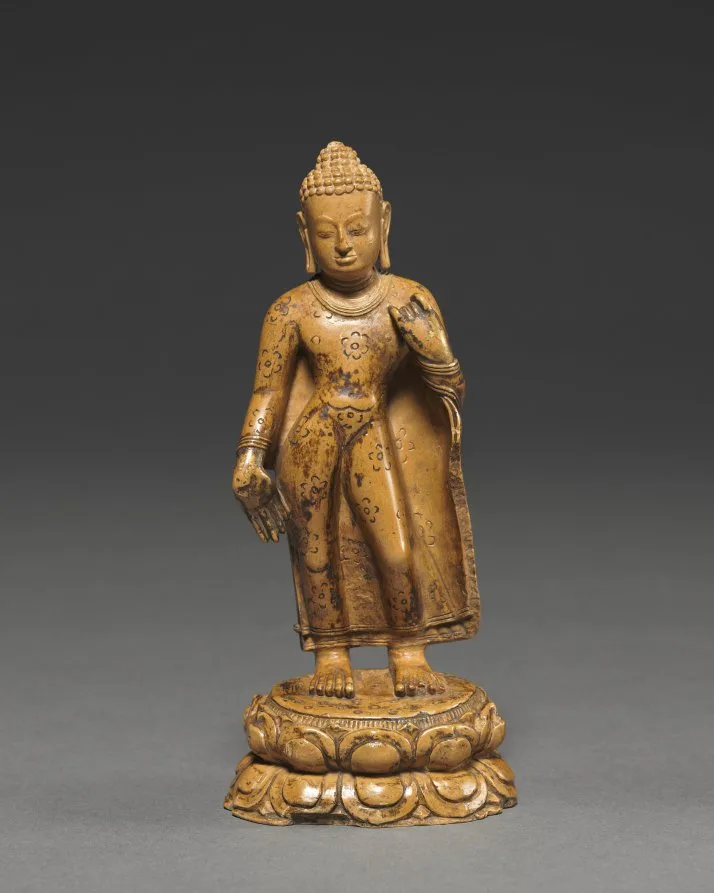
A lowered hand and a flower-covered robe turn a small standing figure into a possible episode from a life story.
Start with the hands rather than the face. The Buddha’s right hand, on our left, points toward the ground with the palm turned outward. The Cleveland Museum of Art connects this gesture with his descent from the Heaven of the Thirty-three Gods, where Buddhist narratives describe him teaching his mother after her rebirth there. The figure may once have belonged to a group showing eight important events in his life.
The sculpture is only about fourteen centimetres tall, yet its maker gave close attention to the folds and flowers of the robe. Follow those small marks down toward the layered petals of the base. The flowers may recall blossoms falling during the descent, an interpretation the museum presents as a possibility. This is a useful lesson in reading religious art: a gesture, a surrounding pattern, and a known narrative can reinforce one another, while the reconstruction of the original ensemble remains uncertain.
The museum describes both the original eight-scene group and the connection between the flowers and heavenly descent as possibilities. A single hand position should not identify every Buddha in every tradition.