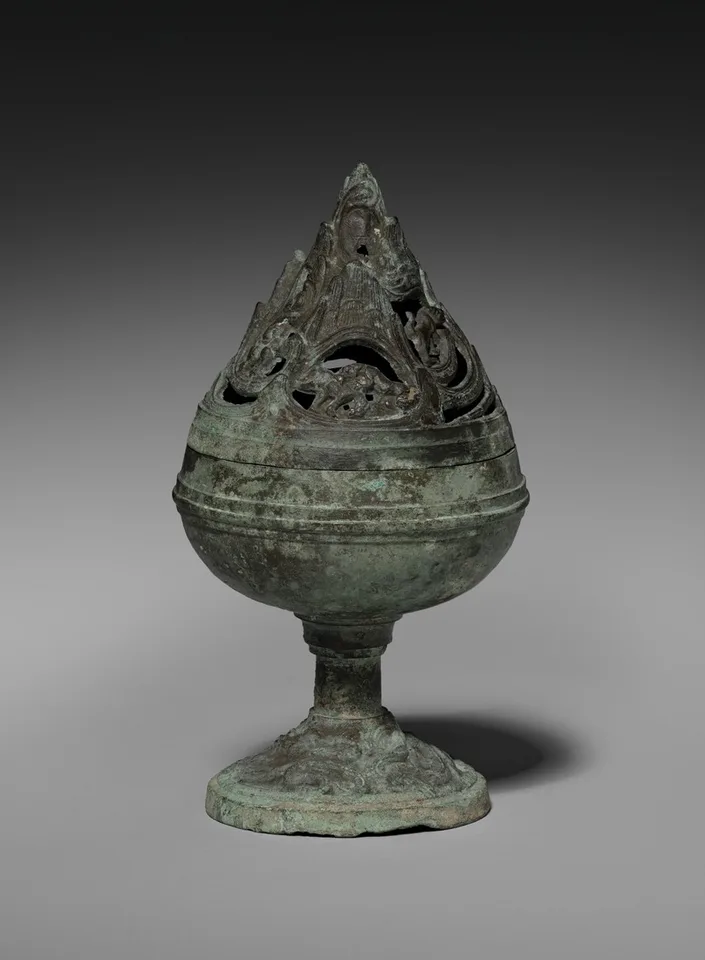
 China, Western Han dynasty (206 BCE–8 CE) · 200–100 BCE
Incense Burner (Boshan Lu)
Maker unrecorded
bronze
Both metal objects contain burning incense and release smoke through pierced surfaces. Their images give that shared operation different imaginative settings: one makes a miniature mountain appear misty, while the other turns an animal’s body into a chamber for scent.
China, Western Han dynasty (206 BCE–8 CE) · 200–100 BCEMaker unrecorded
bronze
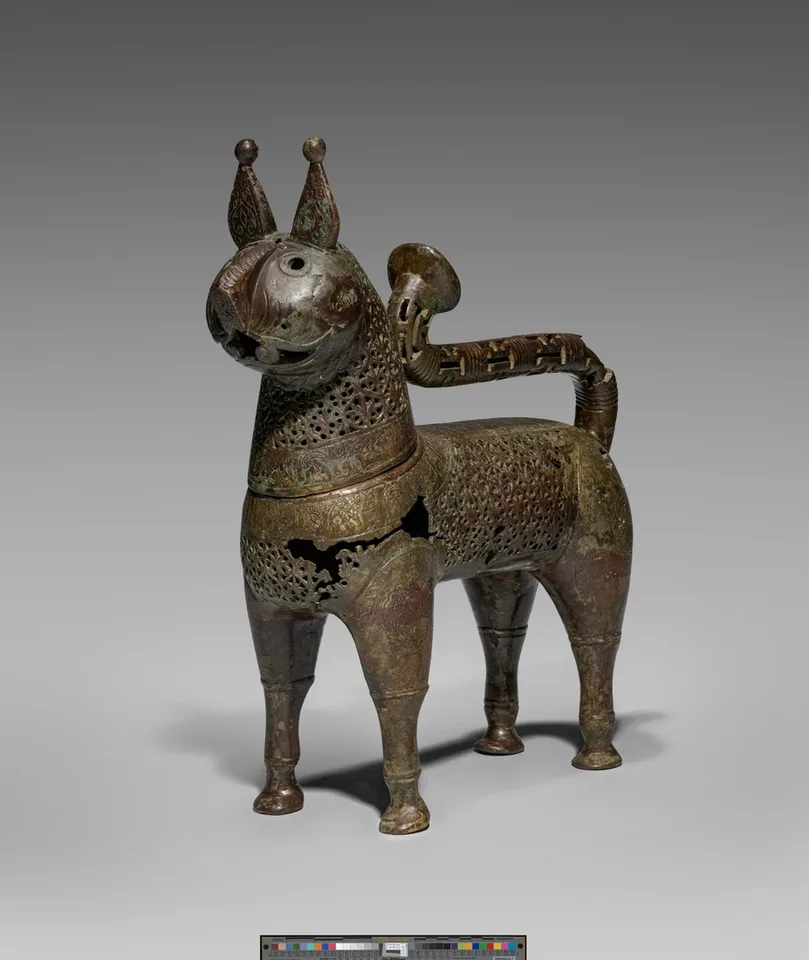 Iran, Khurasan, Seljuq period of Iran (1037–1194) · 1150–1200
Unknown maker
Copper alloy, cast, engraved, chased, and pierced
The mountain’s gaps become passages for mist-like smoke, while the feline’s pierced flank releases scent through ornamental curls. In both, empty space is part of the working design rather than merely a decorative absence.
The Chinese burner has a containing cup beneath its mountain cover. The Iranian feline has a separately cast removable head. These different arrangements let the maker preserve a recognisable image while providing access to the material burning inside.
Hunters and fantastic beings populate the mountain, while Qur’anic writing circles the feline’s neck and spine. Their contextual meanings differ even though both objects join a sensory experience with a carefully worked metal surface.
Shared incense use does not establish a common ceremony or transmission between these objects. The particular scent, original placement and historical users cannot be recovered from the photographs.
The comparison of visible choices is our own reading. Follow either artwork page for its full context, uncertainty note and image-rights record.
Smoke, sound, containment and suspended ceramic.