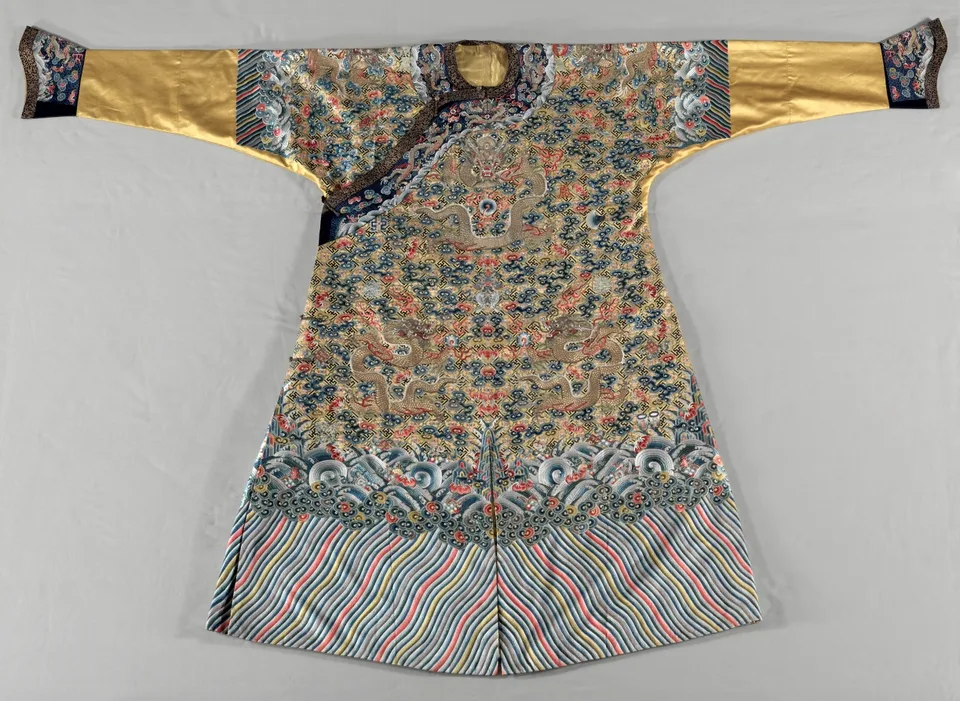
 China, Qing dynasty (1644–1911), Jiaqing period (1796–1820) · late 1700s
Semi-formal Court Robe (Jifu)
Maker unrecorded
Silk: satin weave; silk and metal thread: embroidery
The Qing robe belongs to Chinese court dress, while the Indian-made coat served an aristocratic French market. Compare how their different constructions organise rich imagery around openings and sleeves before imagining each garment on a moving body.
China, Qing dynasty (1644–1911), Jiaqing period (1796–1820) · late 1700sMaker unrecorded
Silk: satin weave; silk and metal thread: embroidery
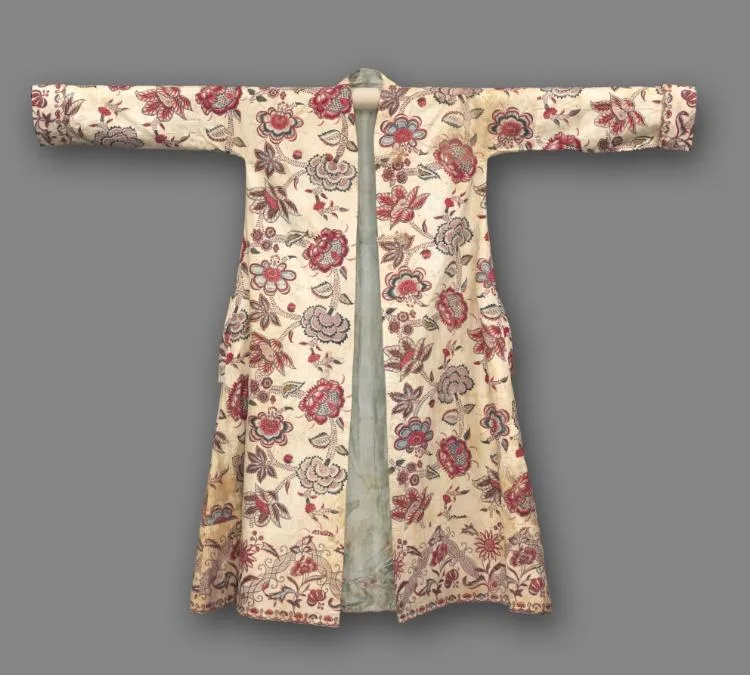 India, Mughal · 1700–1750
Maker unrecorded
cotton: tabby weave, resist-dyed (mordant resist and batik); applied gold leaf
The Qing robe’s dark diagonal edging directs the eye across its front. The morning coat’s opening establishes another route through its patterned textile. These are wearable structures rather than uninterrupted rectangular pictures.
Dragons and clouds occupy a cosmological arrangement on the court robe. Floral motifs repeat across the coat. Similar richness of surface does not give the motifs the same symbolic role or political meaning.
Waves collect around the robe’s lower hem, while the coat’s sleeves shape how its surface would move with an arm. Flat display makes comparison easier but suppresses much of the experience of wearing either garment.
The garments have distinct intended settings: Qing court dress and Indian textile production for aristocratic France. Neither record identifies a particular wearer, and shared richness does not establish shared dress rules.
The comparison of visible choices is our own reading. Follow either artwork page for its full context, uncertainty note and image-rights record.
Bodies, flowers, gold, and borders share woven surfaces.