Read the
Picture
An open collection
China, Qing dynasty (1644–1911), Jiaqing period (1796–1820) · Textile

Semi-formal Court Robe (Jifu)

Maker unrecorded · late 1700s

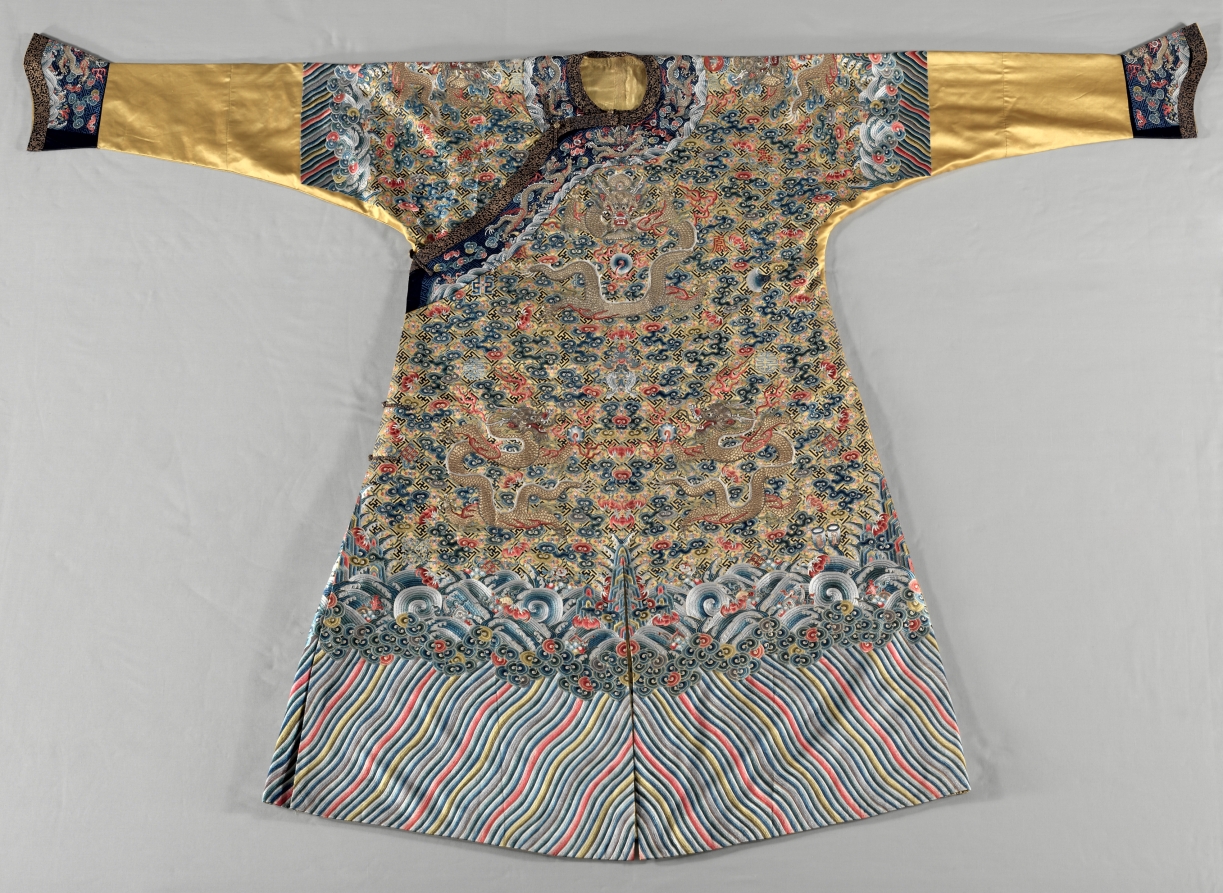
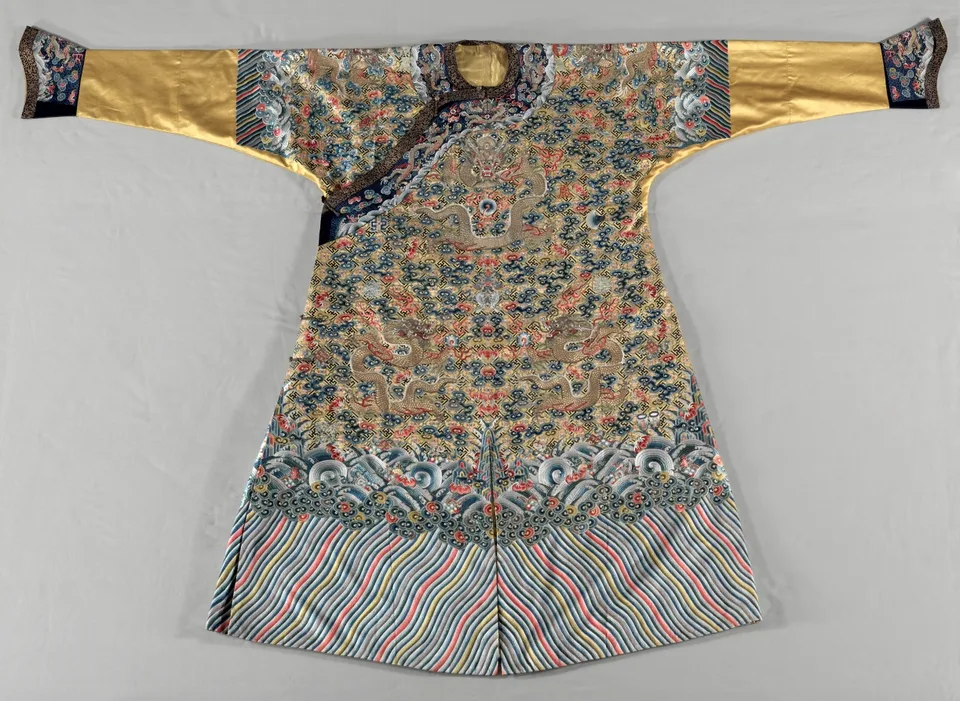
A yellow silk robe is displayed flat with its long sleeves extended. Dense embroidered dragons and clouds fill the body, while dark edging follows the diagonal opening and collar. Repeated wave forms and striped bands occupy the lower hem. The sleeve ends carry contrasting dark cuffs with smaller embroidered motifs.
100%

Drag to move · Pinch or +/− to zoom · Arrow keys to pan · 0 to reset

The Cleveland Museum of Art · 1983.32 · Image: CC0Museum image ↗
A little context

Clouds above waves turn a yellow court garment into a wearable statement about imperial authority and the ordered universe.

The robe arranges its imagery vertically. Waves collect near the hem, rocks rise from them, and dragons move through clouds above. The museum explains this as a diagram of the universe: oceans below the earth and a cloud-filled sky above. The wearer’s body would have brought that organised surface into movement, unlike the flat museum display.

The garment belongs to the Qing court, where yellow clothing was restricted to the emperor and his consorts. Dragons reinforce imperial authority, but the robe’s category matters too: this type was intended for semi-official court meetings rather than the ruler’s principal state rituals. Look at the dark diagonal fastening and extended sleeves as carefully as the central embroidery. Clothing has a structure and a way of being worn, not just a collection of symbols. Comparing it with the Korean Dragon Jar shows that related creatures could connect with rulership in different objects and political settings without making their uses interchangeable.

A careful reading

The museum explains the robe’s court category and imagery, but the photograph does not identify its individual wearer. Imperial colour rules and dragon associations here belong to Qing clothing conventions, not every Asian textile.
Try your eye

What connects the robe’s waves, rocks, clouds, and dragons in the museum’s interpretation?

Where this reading begins

  • Semi-formal Court Robe (Jifu) — collection record — The Cleveland Museum of Art. Supports identification, dating, materials, authorship qualifications and contextual interpretation; close-looking observations describe the individually inspected museum photograph. Museum record updated 2026-06-17; accessed 2026-11-13.

Our observations describe the supplied museum photograph. Historical identifications and context follow the cited collection record; interpretive limits are stated above. This is an independent guide, not a museum endorsement.

Image rights & attribution

Semi-formal Court Robe (Jifu), late 1700s. China, Qing dynasty (1644–1911), Jiaqing period (1796–1820). Silk: satin weave; silk and metal thread: embroidery; width across shoulders: 226.1 cm (89 in.); length back of neck to hem: 154.9 cm (61 in.). The Cleveland Museum of Art, Purchase from the J. H. Wade Fund, 1983.32

Individual API record marked CC0; checked 2026-11-13. CC0 1.0 dedication. Record date: 2026-06-17 11:19:44.711000. Web JPEG downloaded unchanged; responsive WebP and zoom derivatives resized and recompressed; numbered annotation overlay separate from image.