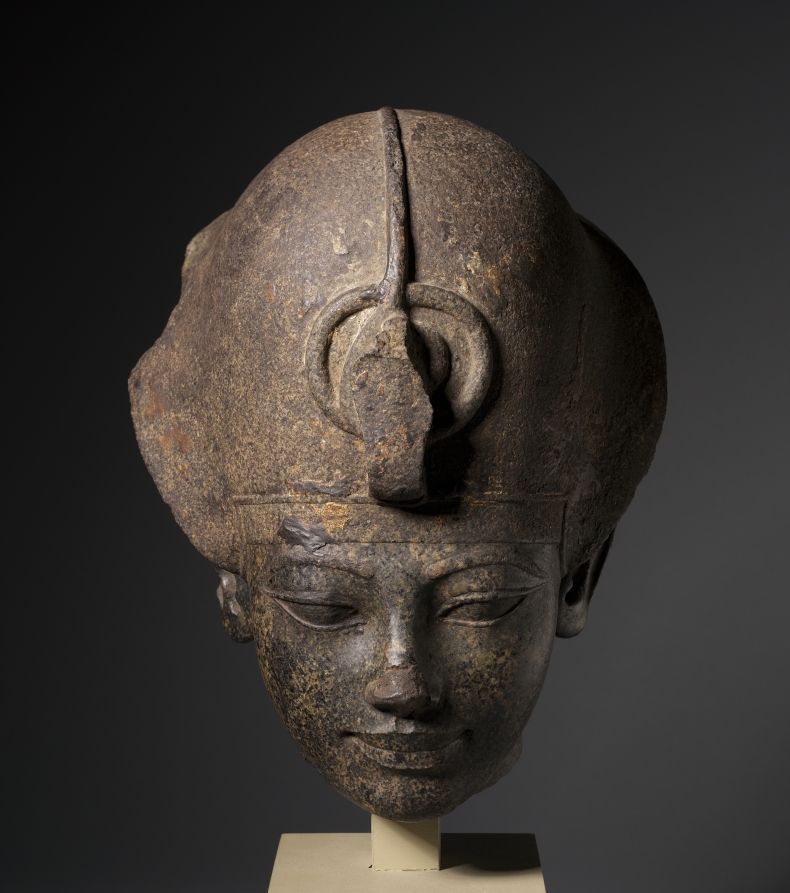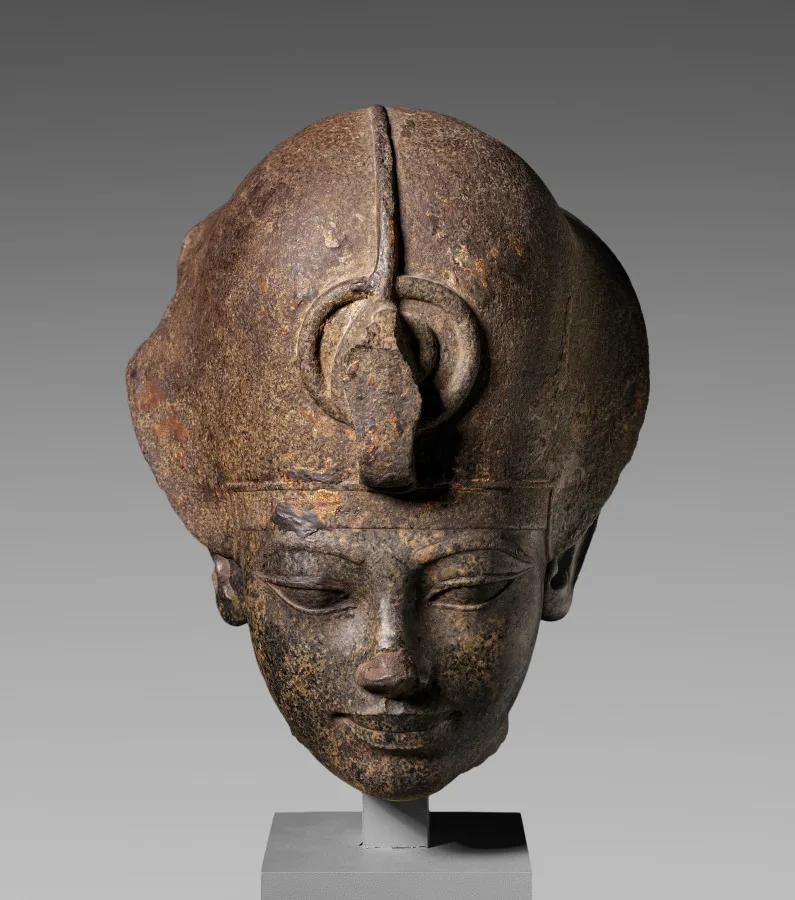
A rougher crown and smoother face reveal that this dark stone royal head once depended on color as well as carving.
The crown dominates the silhouette, but the contrast in finish is just as important. The face catches smooth highlights, while the upper headgear appears rougher. Its central cobra form gives the broad mass a vertical accent. This is a carefully varied surface, not merely a head carved from one uniformly polished block.
The museum identifies Amenhotep III wearing the Blue Crown. The name can confuse a viewer because the surviving stone no longer looks blue. The crown was originally painted, and its rougher finish helped the color adhere; the browband was yellow. The youthful face offers a formal royal presentation rather than a reliable record of how the ruler looked on a particular day. The work is therefore a lesson in lost color and represented identity. A photograph preserves differences in surface well enough to prompt these questions, but documentation is needed to explain the original painting.
The crown's historical name does not describe its present photographed color. The head is an idealized royal image, and its polished features should not be treated as an exact clinical record of the sitter's appearance.
What explains why a 'Blue Crown' is not visibly blue here?
Practise looking at Head of Amenhotep III Wearing the Blue Crown →