Egyptian identifying attributes
Four Egyptian works show how identification depends on selected attributes. A bull’s crown, a queen’s paired cobras, a goddess nursing a child and a king’s distinctive headgear each narrow the possibilities. The route also introduces loss: weathering and missing paint affect the very features used to interpret the objects, so recognition needs both looking and the museum’s research.
Begin the journey ↓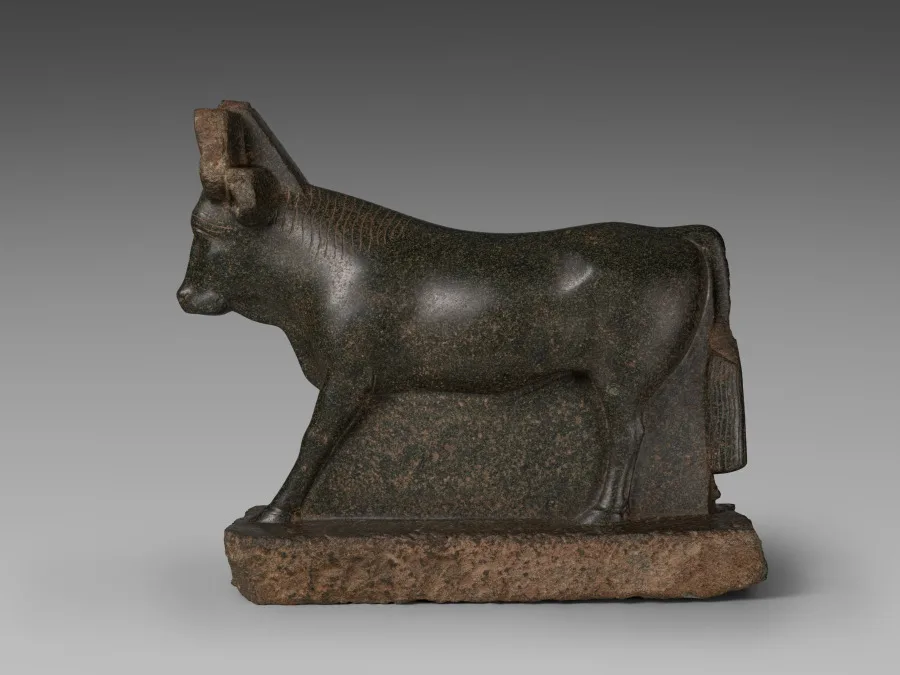
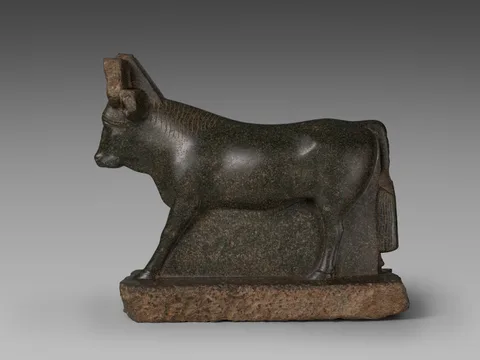
A worn crown above a bull
The upper projection is weathered, but it belongs to the crown that helps identify the animal as Apis. The museum describes a sun disk and cobra. Begin with the surviving silhouette, then distinguish what the photograph preserves from the fuller identification supplied by the record.
Carry this question: What makes the head’s upper profile different from that of an ordinary bull?
Open the artwork ↗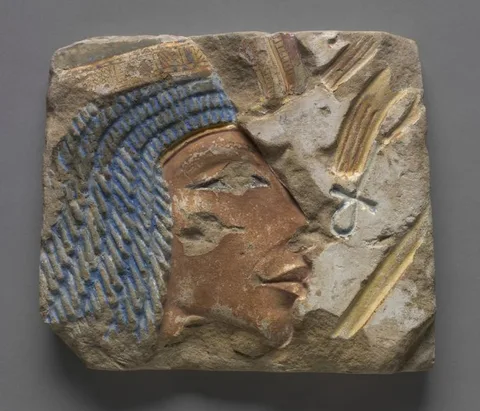
Two cobras at a royal forehead
The paired uraei above the forehead are central to the museum’s identification of Nefertiti. Nearby blue pigment remains in the wig. This fragment came from a larger architectural setting; the remaining face and attributes preserve one part of an image whose original extent is missing.
Carry this question: Which small feature offers more specific identification than the general shape of the face?
Open the artwork ↗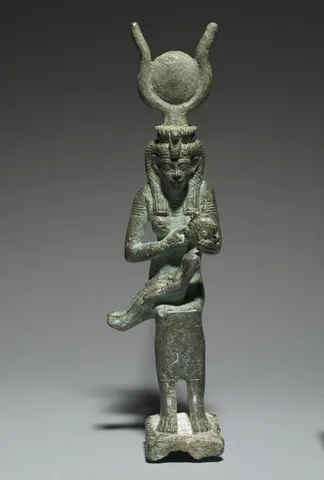
A divine relationship through nursing
The child sits sideways on the seated figure’s lap, with his head near her breast. The crown and nursing group identify Isis and Horus in the museum’s account. The absent wooden throne also reminds us that the bronze’s current support does not recreate its original setting.
Carry this question: How do the arms and the child’s position make the relationship legible?
Open the artwork ↗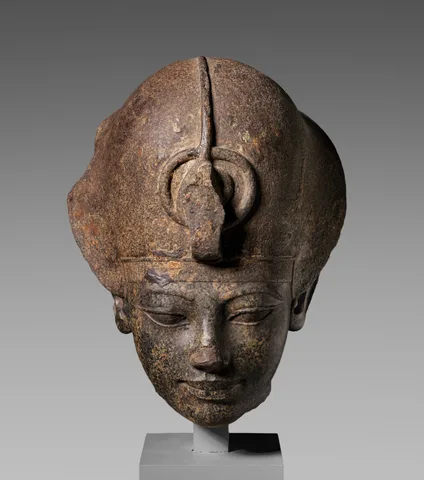
Colour now supplied by context
The crown’s roughened surface contrasts with the smoother face below. The museum explains that the crown was once blue, with a yellow band. Its modern stone colour therefore cannot stand in for its original appearance, even though the broad form remains recognizable.
Carry this question: What evidence of different surface treatment survives after the paint is lost?
Open the artwork ↗Read with the sources
Historical context follows the individual museum records linked on each artwork page. These routes make original comparisons of visible form; resemblance alone is not evidence of shared meaning or direct influence.