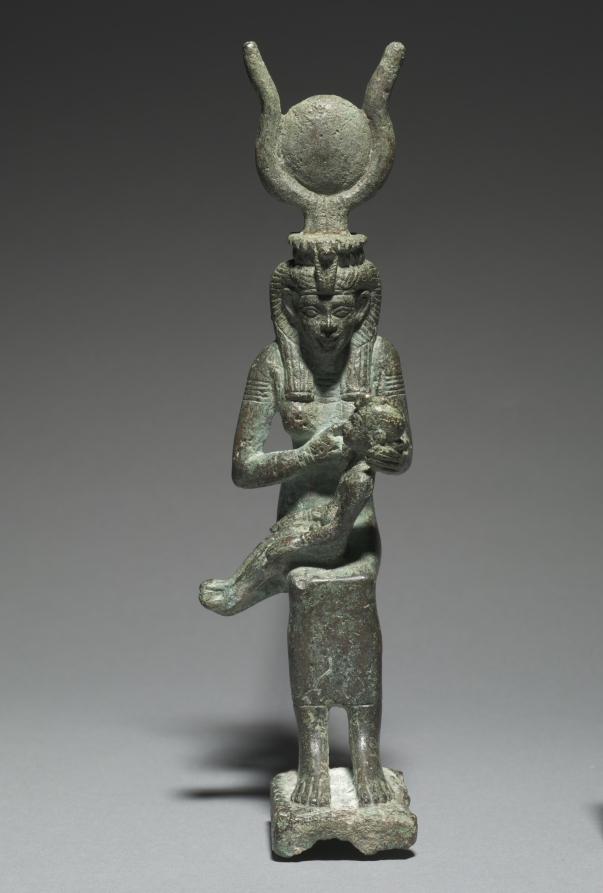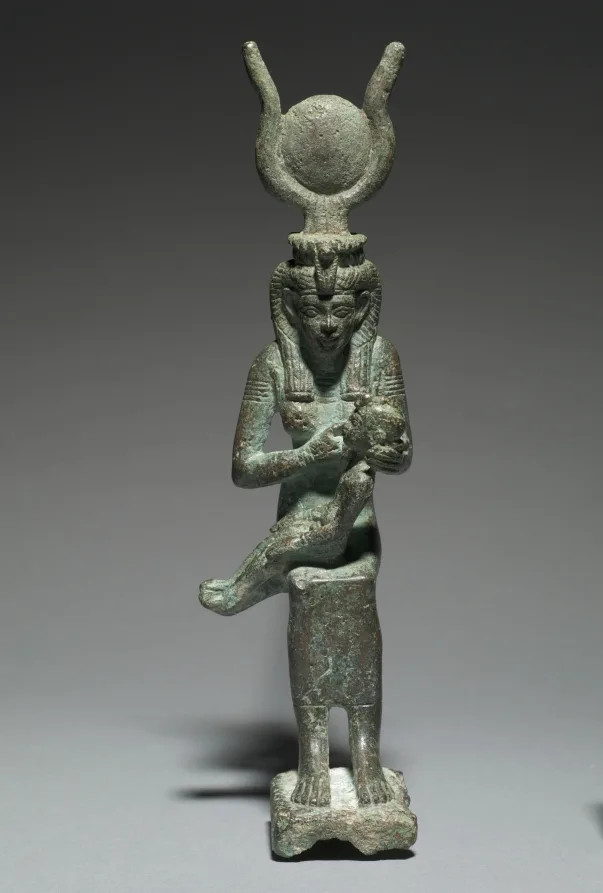
A seated mother and sideways child form an intimate group, while horns, disk and wig identify a divine relationship.
The child sits at a right angle to the mother's upright body, making the nursing relationship readable from the front. One hand supports him while the other approaches the breast. The small gesture contrasts with the large crown above: an intimate bodily action is framed by an elaborate set of divine attributes.
The museum identifies Isis and Horus, a widespread Egyptian sculptural pairing. The striated wig, vulture headdress, cobra, horns and sun disk distinguish the goddess, while details of the child identify youth and royal divinity. The museum also notes that a wooden throne originally supported the figure, now absent. That loss explains why the seated body can look incomplete in isolation. The work invites comparison with other images of nursing, but a similar pose does not prove that all such images share the same belief or direct historical relationship. Its identity depends on this particular ensemble of attributes and context.
The museum supplies alternative broad date ranges. The missing wooden throne is documented but not reconstructed here; similar nursing poses in other traditions should not be treated as automatically equivalent or directly derived.