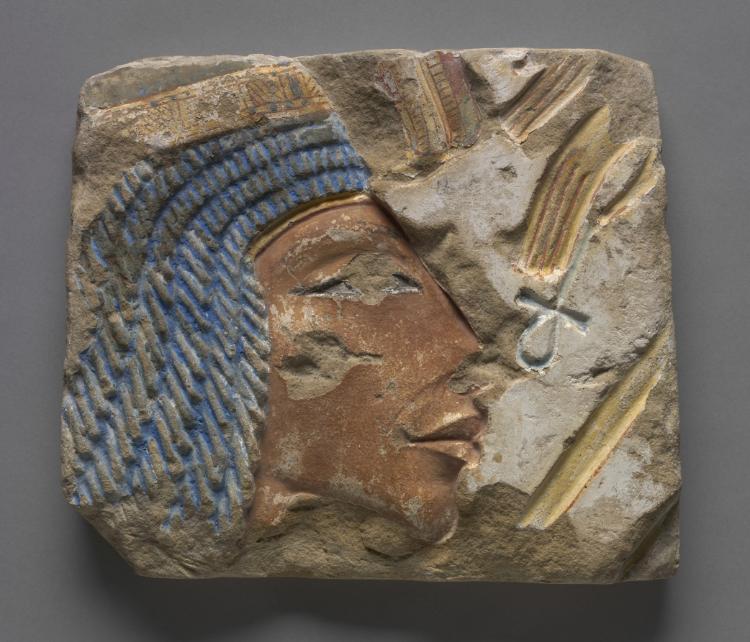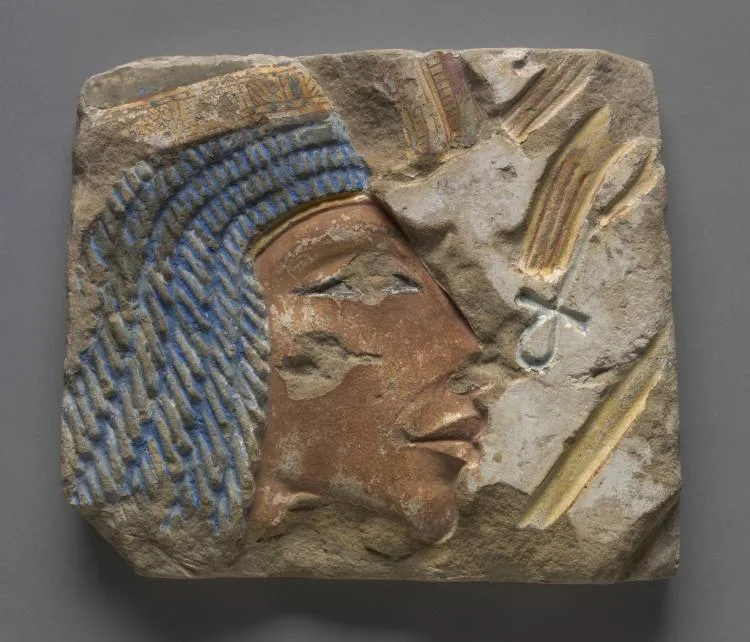
A small fragment preserves a face, blue wig and royal headband, enough evidence for a specific identification despite its broken edges.
The broken stone concentrates attention on a profile that once belonged to a larger temple scene. Blue details repeat down the wig, the headband crosses above the brow, and the face projects clearly against its shallow background. A fragment can preserve enough carefully chosen attributes to carry an identity even when most of the surrounding narrative is gone.
The museum identifies Nefertiti through the double uraeus associated with the queen's headband. The relief came from Akhenaten's Aten temple complex at Karnak, made before the court moved to Amarna. Those temples were later dismantled and their blocks reused in other construction. The fragment therefore records both an original royal religious project and its ancient disruption. The museum notes that Nefertiti appears unusually often in this material, but leaves the reason unresolved. Her prominence is evidence to investigate, not permission to supply an unsupported account of her precise political power.
The reason for Nefertiti's frequent appearance in the temple reliefs remains unknown in the source. The fragment does not preserve the whole scene, and surviving paint is not a complete original color scheme.