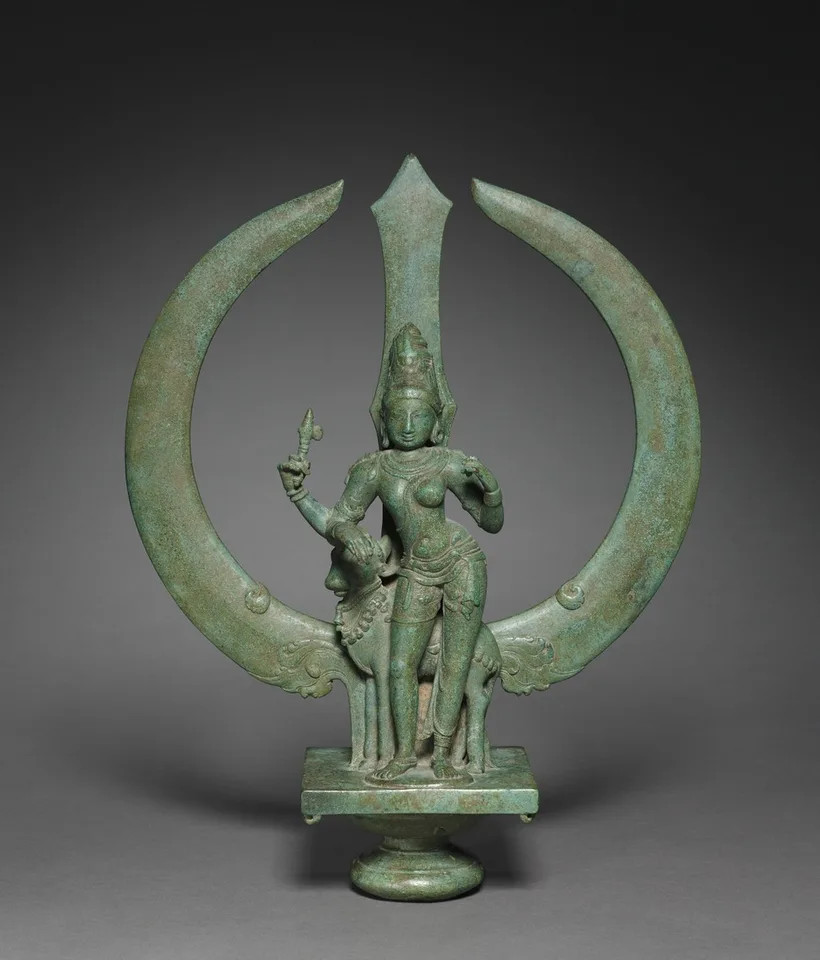
A great trident frames a divided yet unified body, making different gendered attributes parts of one divine presence.
The trident is not simply an object held beside the deity; it frames the entire body. Its outer prongs open like a large curve around the figure, while the central blade rises directly above the head. Within that strong outline, the body is divided by different attributes, clothing and proportions. Looking carefully at each side reveals a single form built from contrasts.
The museum identifies Ardhanarishvara, Shiva as half woman. The figure’s left side carries a crown, earring, breast, broad hip and long skirt; the right has a yogi’s matted hair and an axe, with the bull beside it. The lower hands probably held a stringed instrument, now absent. The image expresses Shiva’s encompassing of apparently opposed qualities, including creative and destructive, royal and ascetic. Each side contributes distinct attributes, while the shared body and enclosing trident hold them together.
The lower hands probably held a lost instrument, so that detail remains a reconstruction. Left and right refer to the figure’s own body: the female side appears on the viewer’s right.
How does the object’s overall shape reinforce its subject?
Practise looking at Trident with Shiva as Half-Woman (Ardhanarishvara) →