Sacred forms and built settings
Sacred imagery may be framed by a weapon, arranged in a dancing group, built into a doorway or attached to transport. Follow how the object’s overall structure supports its imagery. A familiar creature or gesture can serve different roles when its material setting changes.
Begin the journey ↓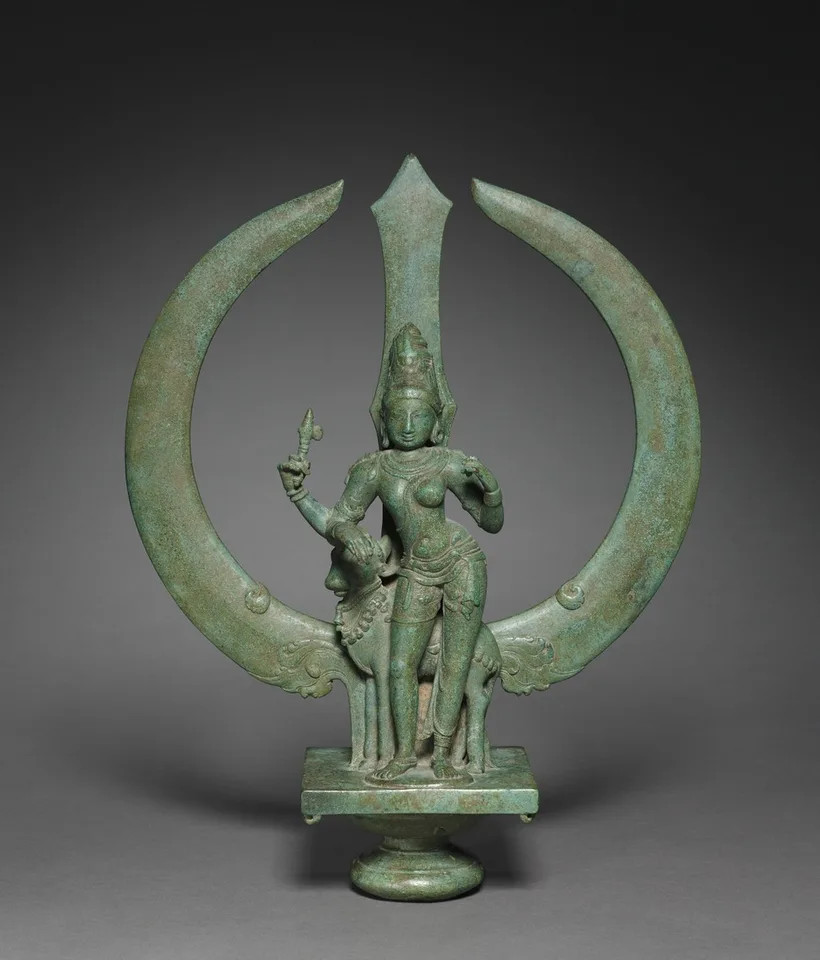
Frame a combined body
The large trident holds different gendered attributes within one outline. Its shape reinforces the integrated divine form, while the probable lost instrument keeps part of the original configuration uncertain.
Carry this question: How does the weapon become more than an attribute beside the body?
Open the artwork ↗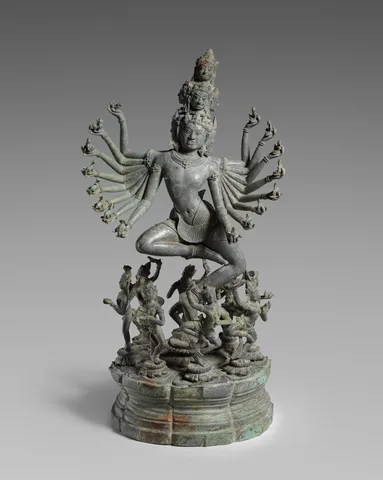
Organise a sacred group
Eight smaller dancers echo the central deity’s movement. Their ring gives the complex sculpture an order that can be recognised before every tiny held object is identified.
Carry this question: Which repeated movement helps you understand the whole group?
Open the artwork ↗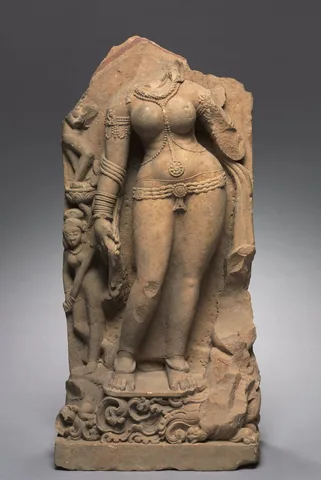
Recover a threshold role
The surviving makara helps identify a damaged goddess whose image belonged at a temple entrance. The architectural context restores purpose without pretending that the lost head or doorway survives.
Carry this question: Which lower detail provides information that the missing head cannot?
Open the artwork ↗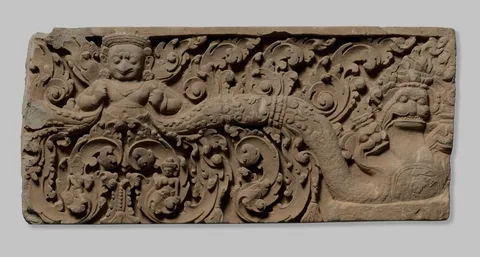
Read growth across a doorway
Foliage resolves into cobra heads beneath Garuda, making ornament part of a specific relationship between creatures. The lintel’s role places that animated growth over an architectural opening.
Carry this question: Where does a decorative stem become a creature?
Open the artwork ↗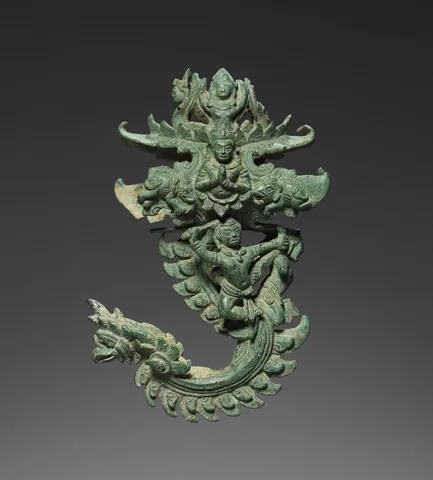
Carry weight through imagery
The curling hook supported a suspended seat while its end became Garuda’s face. Ceremonial meaning and load-bearing construction occupy the same bronze fitting.
Carry this question: How does knowing the suspended load change your reading of the curve?
Open the artwork ↗Look at a pair more closely
- When foliage becomes a creature
A Khmer lintel and an Ottoman drawing
Read with the sources
Historical context follows the individual museum records linked on each artwork page. These routes make original comparisons of visible form; resemblance alone is not evidence of shared meaning or direct influence.