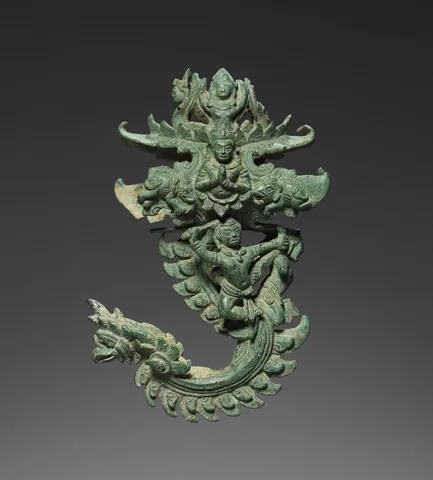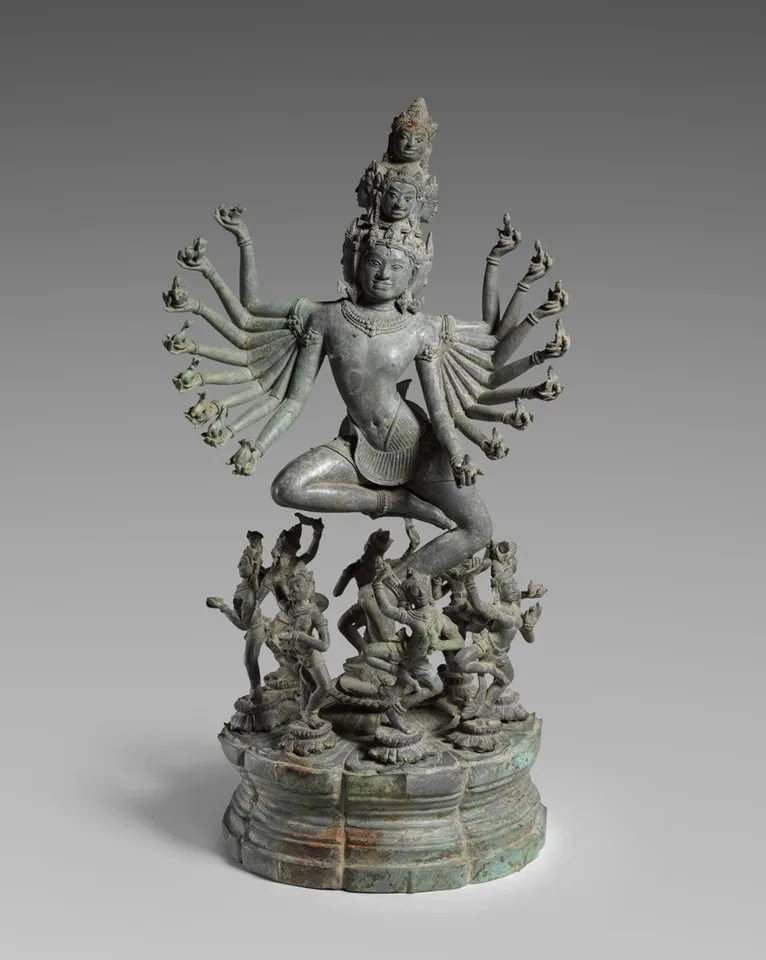
A fan of arms and a ring of dancers make enlightenment appear as a vigorous, carefully organised event in bronze.
The arms create an ordered fan around a body caught in vigorous movement. Small objects rest in the hands, while stacked heads extend the figure upward. Below, a circle of smaller dancers repeats the activity at another scale. The composition is dense, but its rhythms are clear: radiating arms above, bent legs at the centre and a ring of bodies around the base.
The museum identifies Hevajra, important in tantric Buddhist practice under King Jayavarman VII. The deity’s sixteen hands hold skull cups containing animals and divine figures, and eight yoginis surround him. His dance over a corpse is interpreted as overcoming ignorance. Material analysis of the clay core connects the sculpture with the Isaan plateau in present-day northeastern Thailand, within the former Angkor kingdom. This evidence is different from an excavated findspot, and not every small attribute can be securely distinguished in a frontal overview.
The regional attribution draws partly on material analysis rather than a documented excavation. The many small attributes require the museum’s iconographic study and are not all legible in one view.