Read the
Picture
An open collection
Cambodia, probably Angkor · Metalwork

Palanquin Hook

Unknown maker · 1175–1230

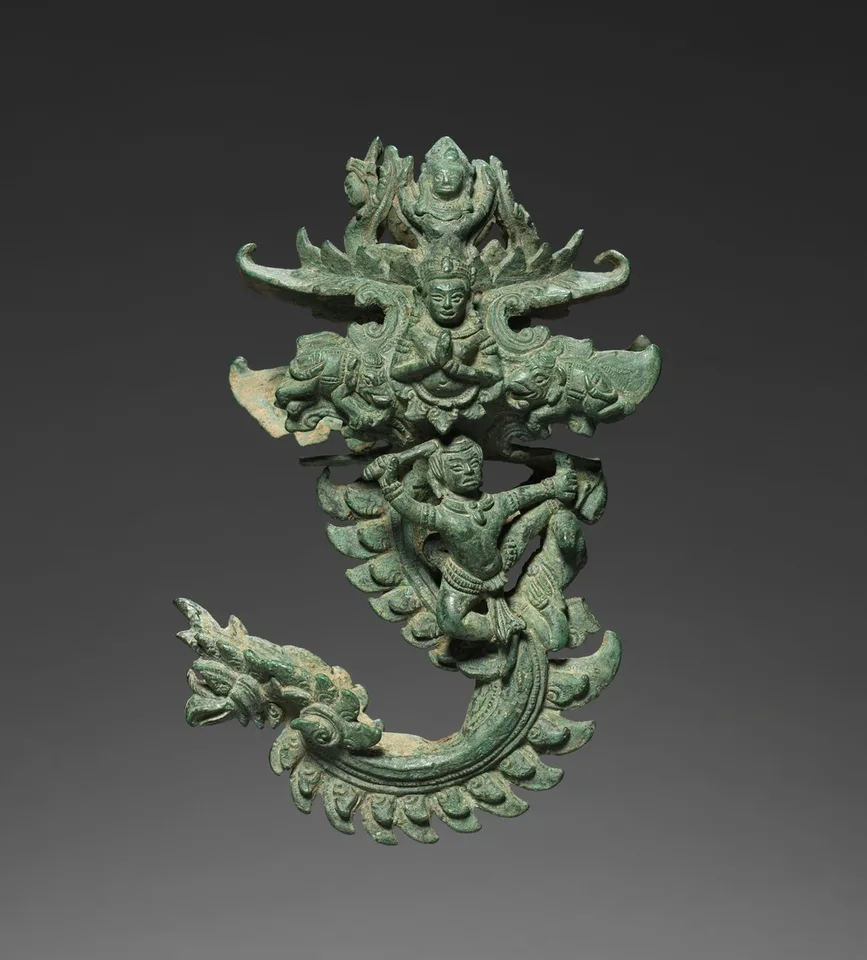
A green-patinated bronze fitting has a large curling hook ending in a beaked face at the lower left. Leaf-like projections follow the outside of the curve. Several small figures rise above it, including one with joined hands, while paired elephant-like animals extend to either side. Open spaces separate the figures from the curved supporting structure.
100%

Drag to move · Pinch or +/− to zoom · Arrow keys to pan · 0 to reset

The Cleveland Museum of Art · 1982.12 · Image: CC0Museum image ↗
A little context

Look beneath the crowded figures to find the curve that once carried a suspended seat.

The large curve at the bottom makes the object’s job visible before its many small figures can be identified. The museum explains that this hook once supported a bronze ring, from which a seat hung like a swing or hammock. A wooden pole passed through a hollow socket above and was carried by bearers. The surviving bronze is therefore one fitting from a larger arrangement involving other materials and people; it was not designed simply to stand as an independent sculpture.

The decoration made that practical arrangement suitable for a ceremonial setting. The museum describes palanquins carrying members of royal families or the priesthood, as well as sacred objects, in processions and journeys to temples. On this example the hook terminates in Garuda’s face, while other figures and paired elephants crowd the upper structure. The record associates those figures with devotion and success. Made in Cambodia, probably Angkor, around 1175–1230, the fitting joins mechanical support with imagery that could be seen as it moved. The original passenger or sacred object associated with this particular hook is not identified.

A careful reading

The wooden pole, suspension ring and seat are absent. The museum describes the type’s ceremonial uses, but this photograph does not identify the original passenger or reconstruct a complete palanquin.
Try your eye

Which surviving feature most clearly explains the object’s supporting function?

Where this reading begins

  • Palanquin Hook — The Cleveland Museum of Art. Individual museum record supplies the qualified identification, material, date and historical context; observations refer to the inspected museum print photograph. Museum record updated 2026-08-03 14:20:32.452000; accessed 2026-11-14.

Our observations describe the supplied museum photograph. Historical identifications and context follow the cited collection record; interpretive limits are stated above. This is an independent guide, not a museum endorsement.

Image rights & attribution

Palanquin Hook, 1175–1230. Cambodia, probably Angkor. Bronze; overall: 17.4 cm (6 7/8 in.). The Cleveland Museum of Art, John L. Severance Fund, 1982.12

Individual API record marked CC0; checked 2026-11-14. CC0 1.0 dedication. Record date: 2026-08-03 14:20:32.452000. Complete museum print photograph resized and recompressed for local overview and WebP derivatives; numbered details are a separate overlay. No cropping or generated replacement.