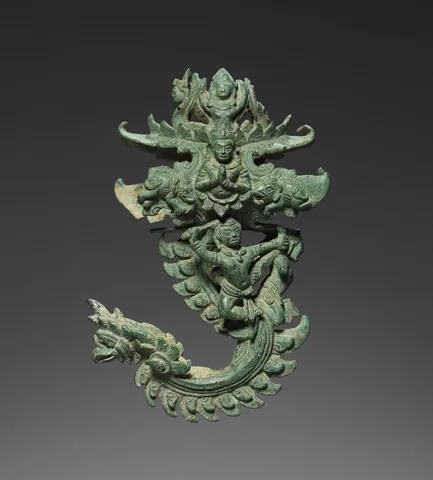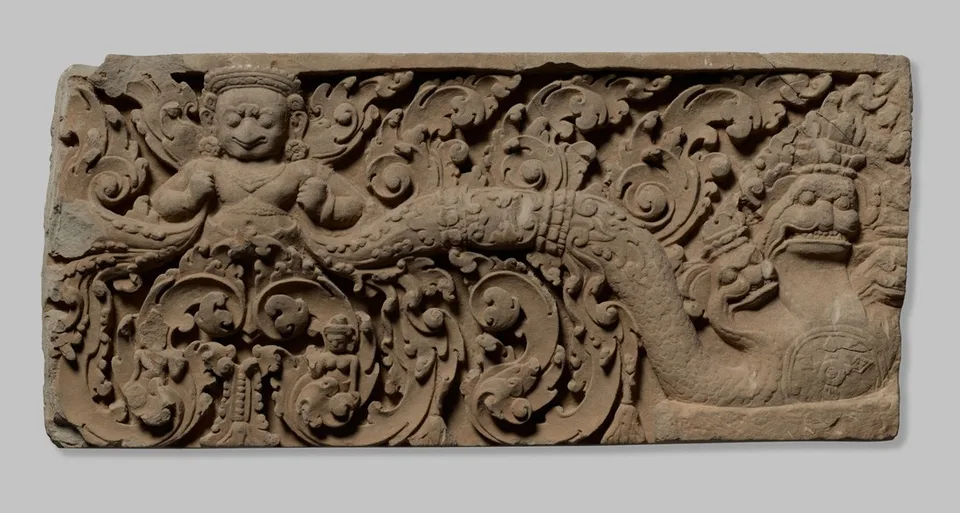
Follow the stone foliage as it becomes wings, human figures and serpent heads.
The foliage does much more than fill the background. Broad curling forms spread across the panel, turn into wings and frame small figures. At the right, a stem seems to resolve into a cobra’s head. Deep cuts create dark spaces between the leaves, making the stone appear more open than its weight suggests. The principal figure is placed toward the left of this surviving view, so the photograph should not be mistaken for a complete doorway or a reconstructed architectural arrangement.
The museum identifies that figure as Garuda, the part-human, part-eagle mount of Vishnu. It explains the serpents in relation to Garuda’s traditional opposition to them and describes the imagery as a distinctly Khmer treatment of forms associated with auspicious doorways. The lintel is dated around the late ninth or early tenth century in Cambodia. Its decoration would have been encountered as architecture, rather than as an isolated framed picture. That setting gives the carved growth and creatures a relationship with passage into a sacred space, while the particular original temple is not identified in the supplied record.
The original doorway is not reconstructed here, and the supplied record does not identify a specific temple for this fragment. The photograph’s composition is not the entire architectural setting.