A small gold disk holds rings of repeating forms, but its wearing history carries a larger story of court office.
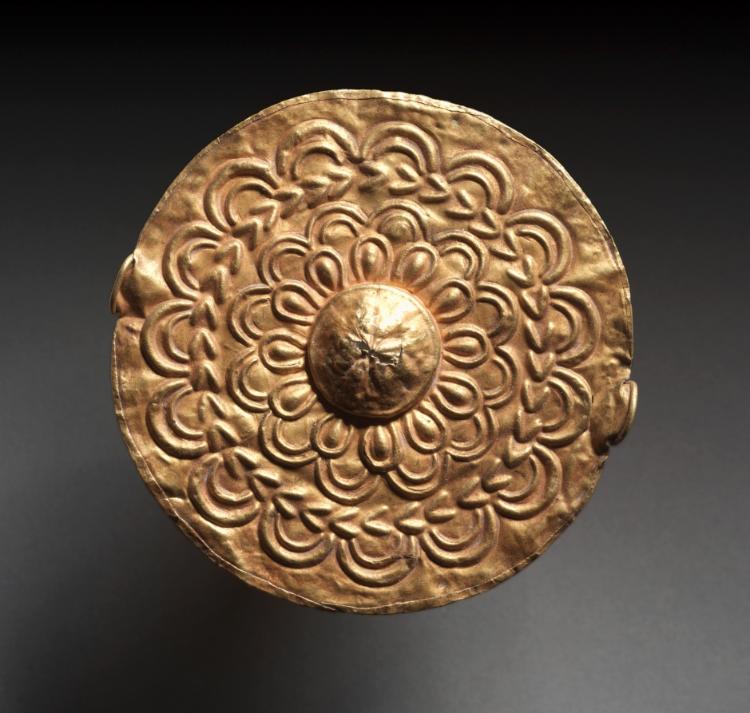
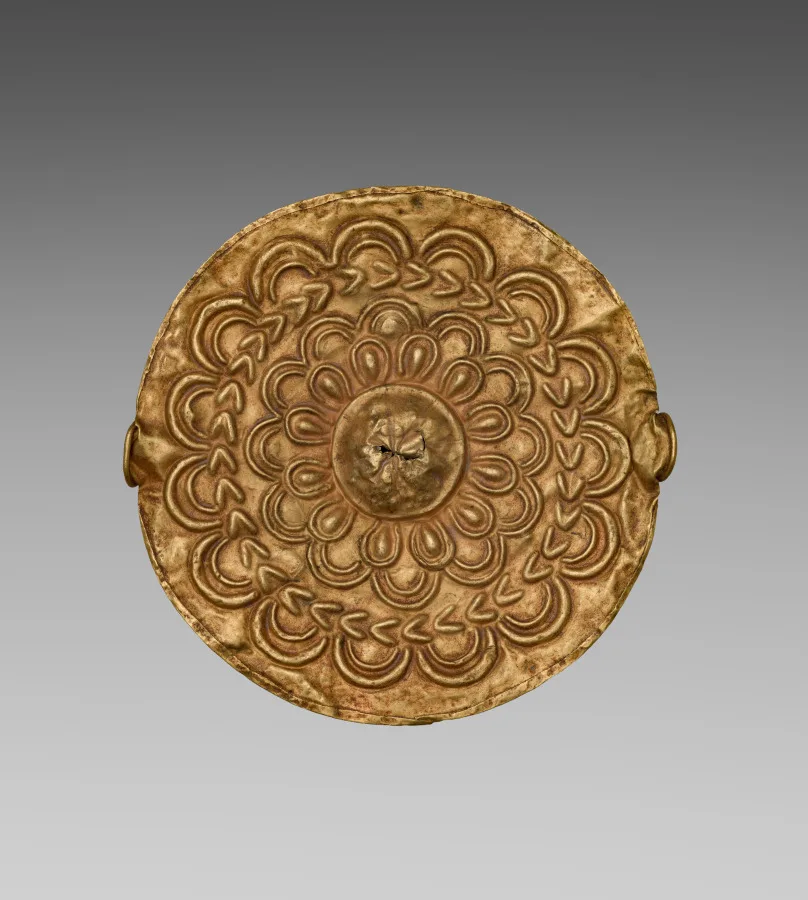
Start at the central boss and move outward. Repeating loops form one ring, more complex curved shapes form another, and a narrow irregular edge encloses the whole design. Two side attachments interrupt the circle, reminding us that this was something worn rather than merely admired as a flat pattern. Reflections and dents also reveal a worked material rather than a perfectly uniform yellow surface.
The museum places this ornament in Asante court culture, where gold disks marked the rank and duties of officials. It reports that King Prempeh I owned this example, while retaining qualification around that association. The British emptied his treasury after deposing and exiling him in 1896. Ornament, office and the later history of removal belong together here. The museum proposes possible relationships with North African coins and water-ring patterns, but those suggestions should not be turned into a single certain origin for every part of the design.
Prempeh I's ownership is reported rather than established without qualification. Proposed coin and water-ring influences concern interpretation of form; they do not prove one direct source for this particular ornament.