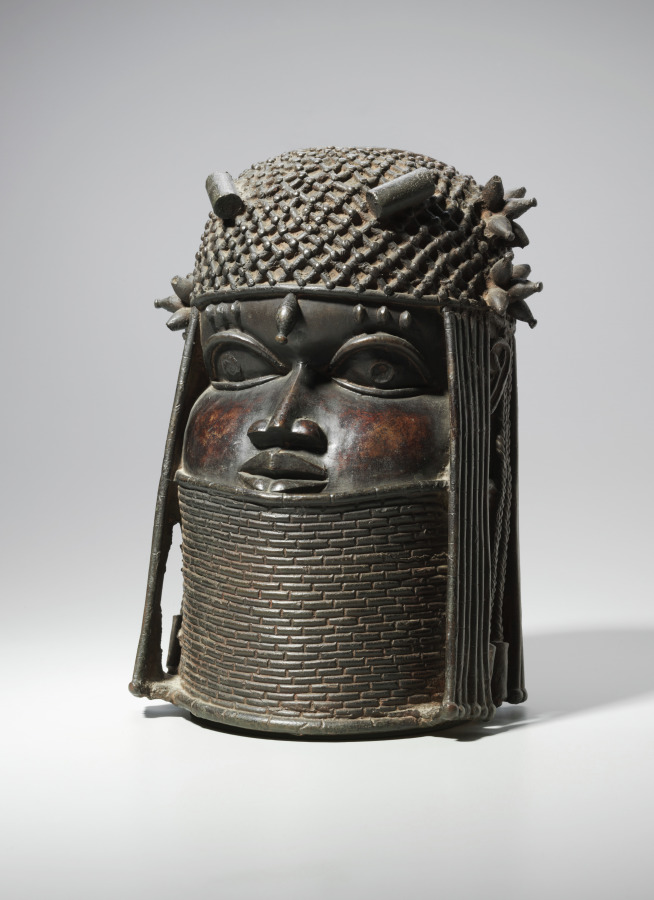
A tall collar and a netted cap frame an idealized royal face, once part of an ancestral altar rather than a gallery.
The collar almost becomes an architectural support for the face. Its repeated bead rows climb to the chin, while the cap repeats a different pattern above the forehead. Between them, the eyes and mouth are comparatively smooth and restrained. Royal presence emerges from the relationship between face and regalia rather than from a uniquely expressive moment.
The museum identifies this as a commemorative head of an Ọba of Benin, made for an ancestral altar. A new ruler commissioned such objects in honoring a predecessor, and this head once supported a tusk. Although commemorating an individual, its features present an ideal rather than a straightforward likeness. The museum contrasts its former religious setting with its present public display. That change matters: an image made for relations between rulers and ancestors is now encountered through a museum photograph, without the altar's other objects, participants or actions around it. The museum’s provenance records that this object was brought to Europe following the 1897 Siege of Benin.
The date remains qualified and no particular Ọba is named in the cited description. The record gives an altar context; the displayed head should not be mistaken for a complete surviving altar ensemble.
What material is represented by the many rows around the neck?
Practise looking at Ancestral Commemorative Head (uhunmwun-elao) →