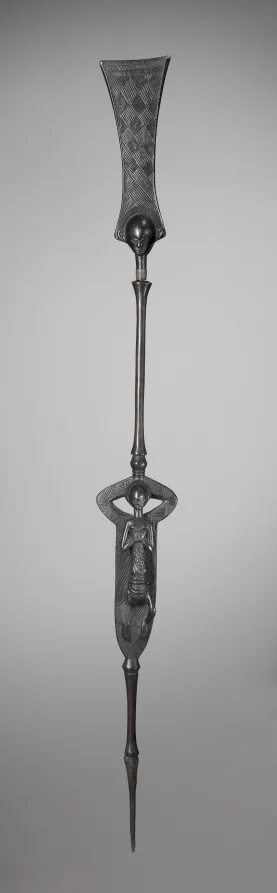
Follow a long staff from its decorated upper blade to its iron point, passing a carved body along the way.
This staff asks the eye to travel vertically. A broad decorated upper section gives way to a slender shaft, a carved figure interrupts the middle, and a pointed metal end closes the sequence. The changes in width make the object readable as a series of linked forms rather than one uniform rod. Its narrowness also reminds us how much a single front view leaves unseen.
The museum identifies the object as Luba royal regalia and describes its sanctification by a ritual specialist. It also records a more complicated ownership history: Chief Msidi, ruler of the Yeke kingdom, gave the staff to the missionary Frederick Stanley Arnot. How he acquired an emblem associated with another kingdom remains an open question. Cultural attribution therefore identifies an artistic and political tradition without supplying the whole biography of this individual object. Its visible structure and its documented movement deserve equal attention.
The museum explicitly leaves unresolved how Chief Msidi acquired this Luba-associated staff. Ritual efficacy is a historical belief recorded by the museum, not a property independently demonstrated by the photograph.