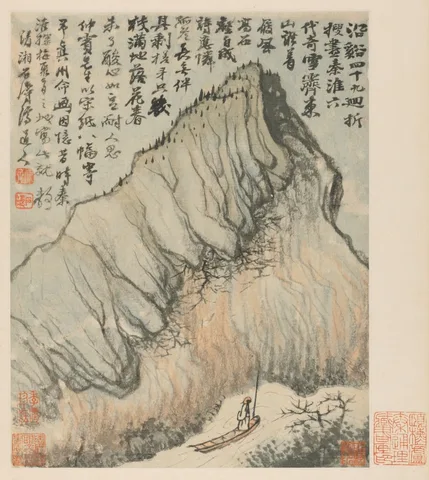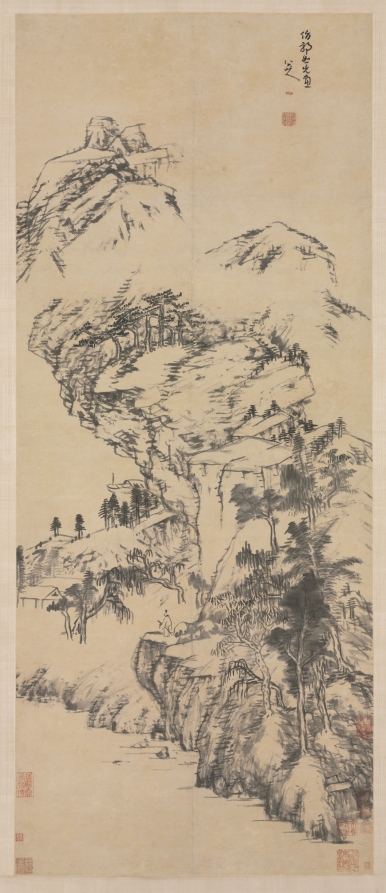
Broken-looking mountain strokes become a personal landscape, even while the inscription names a much older artistic model.
The landscape rises in stages rather than opening into a single measured view. Near the bottom, pale space separates a rocky shore from the viewer. Farther up, small trees and structures give the eye places to pause before the slopes become increasingly dense. Bada Shanren’s abbreviated marks do not describe every surface smoothly; their differing directions are part of what makes the landscape active.
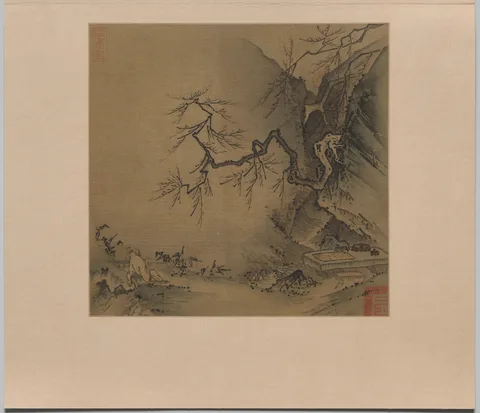
Bada Shanren, also known as Zhu Da, belonged to the former Ming imperial family and lived through the establishment of the Qing dynasty. The museum connects his artistic independence with that complicated life, while avoiding a single code for every mountain. The inscription names the earlier painter Guo Zhongshu as a model, yet the museum finds little direct stylistic resemblance. “After” can therefore signal an artistic conversation rather than a close copy. Compare the visible work of ink here with the more steadily modelled rocks in Playing the Qin in a Secluded Valley.
The inscription’s named model does not mean this is a faithful copy of a surviving Guo Zhongshu painting. Political biography provides context but does not establish a fixed meaning for every brushstroke.