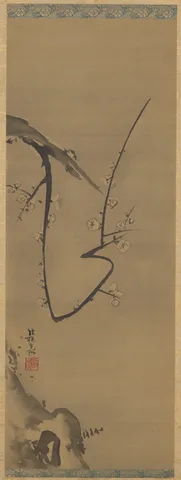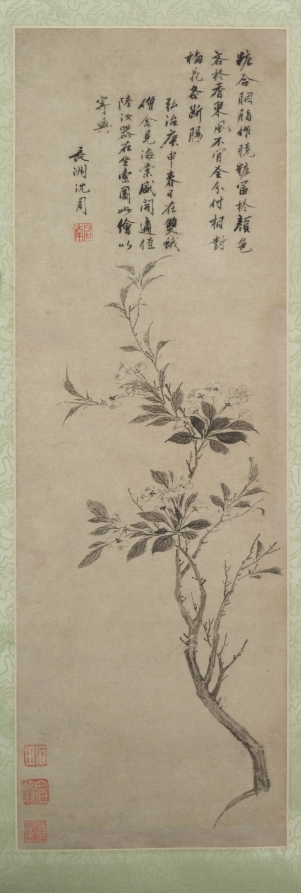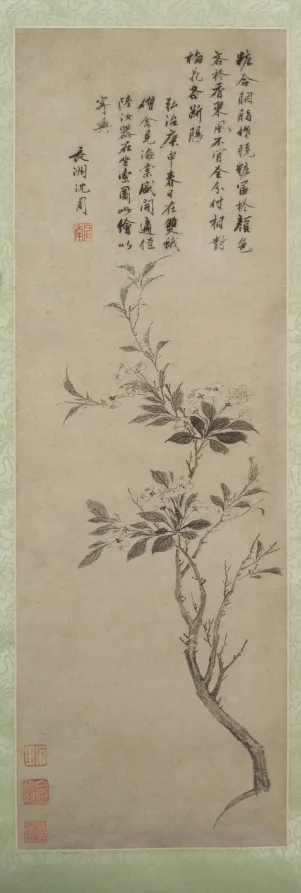
A single cut branch asks us to follow the movement of ink before imagining an entire tree or garden around it.
This is a fragment of a plant, not a view of a whole tree in its surroundings. The branch rises through the narrow sheet with a slight S-shaped movement. Leaves gather in dark clusters, while petals remain comparatively pale inside their fine outlines. The museum identifies this approach as a broken-branch composition, allowing the painter to concentrate attention on a small piece of nature.
Shen Zhou made the work in 1500, late in his life, as an informal presentation picture. His poem above the branch comments on the blossom’s colour and emotional atmosphere, although the painting itself uses ink rather than coloured petals. Follow the connection between the writing and the plant: both depend on controlled marks, varied density, and the spaces between strokes. The work offers a useful comparison with Ink Bamboo, where unpainted support also helps define living forms without reproducing the full colour of a garden.
The poem’s emotional associations belong to this particular painting and its literary setting. The branch is a selected fragment, so the image cannot establish the full shape or growing conditions of a tree.