Landscapes of attention
A landscape can give the eye a route without reproducing a place as a map. Follow figures, branches, rock masses, and inscriptions through these five works. Each makes a different relationship between a visible setting and the memory, literary association, or artistic conversation that helps explain it.
Begin the journey ↓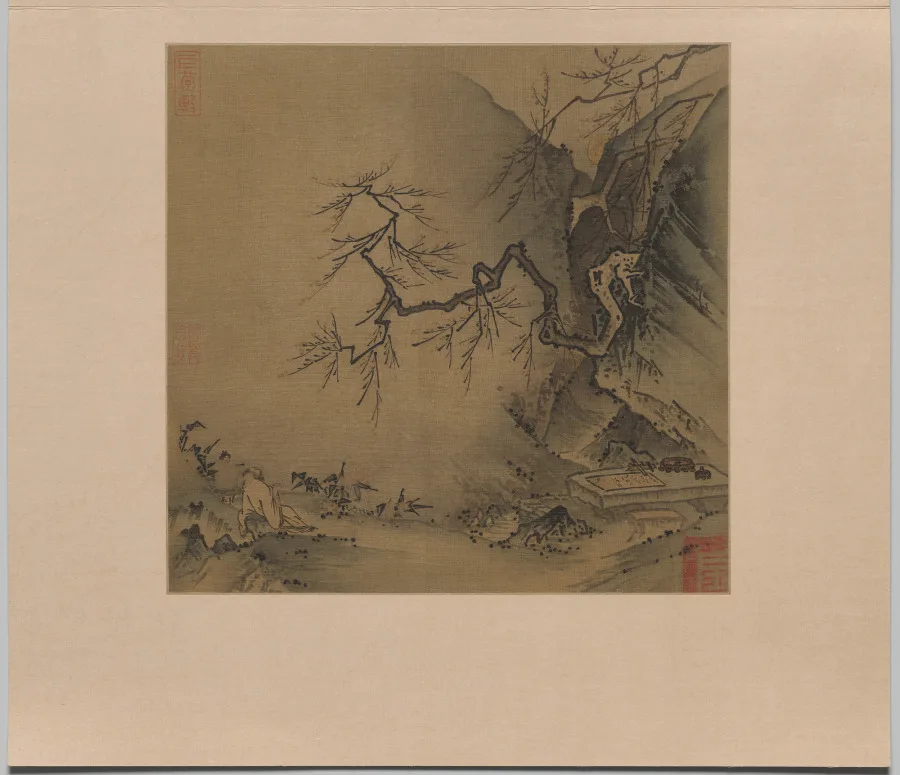
A pause between activities
Locate the reclining drinker and the separate writing table. The space between them leaves room for an imagined sequence, while the museum keeps the proposed site and attribution qualified.
Carry this question: What is happening now, and what is only a possible next action?
Open the artwork ↗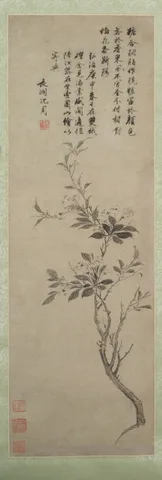
A fragment becomes enough
Follow the bending branch rather than supplying an entire garden around it. The poem and flower share a narrow field, letting a selected fragment carry a much larger literary response.
Carry this question: How does the branch move through the narrow field?
Open the artwork ↗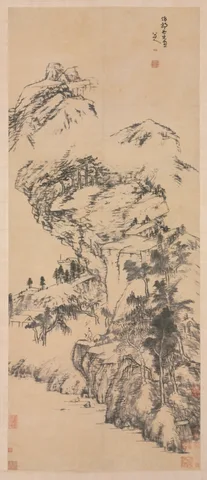
A predecessor named, a style transformed
Look at the inscription and then at the irregular mountain marks. The named earlier model does not require close copying; the museum stresses the artist’s individual handling of the landscape.
Carry this question: Does naming a model mean reproducing its appearance exactly?
Open the artwork ↗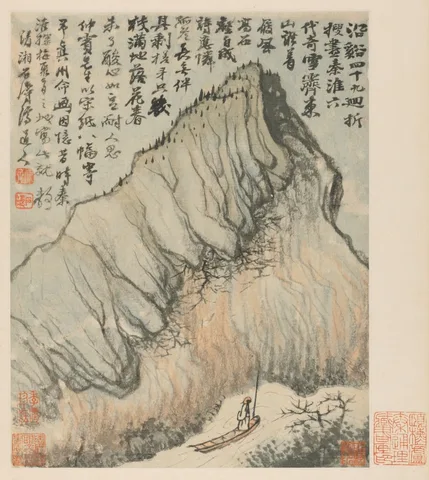
A boat below history
Find the tiny boat at the cliff’s foot. Its scale is visible evidence; the suggestion that the cliff evokes Nanjing’s historical weight is a further interpretation, not a measured geographical fact.
Carry this question: How much of the cliff’s scale depends on the boat?
Open the artwork ↗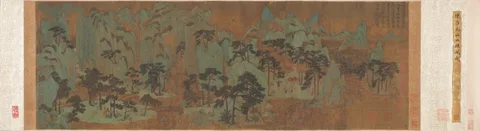
A visitor above ordinary travel
Find the small airborne crane rider. This detail helps establish an imagined immortal realm, while the long scroll distributes discoveries through valleys instead of placing one event at the centre.
Carry this question: What changes when you discover the figure above the valley?
Open the artwork ↗Look at a pair more closely
- How small can a figure become?
Leisure beneath a tree and a boat below a cliff
- Two ways to make a pale blossom
Shen Zhou’s outlines and Kōrin’s reserved silk
Read with the sources
Historical context follows the individual museum records linked on each artwork page. These routes make original comparisons of visible form; resemblance alone is not evidence of shared meaning or direct influence.