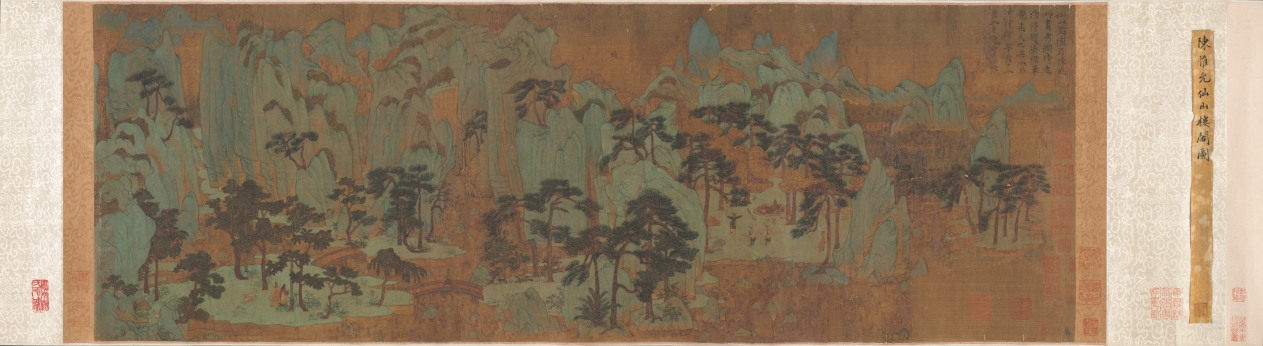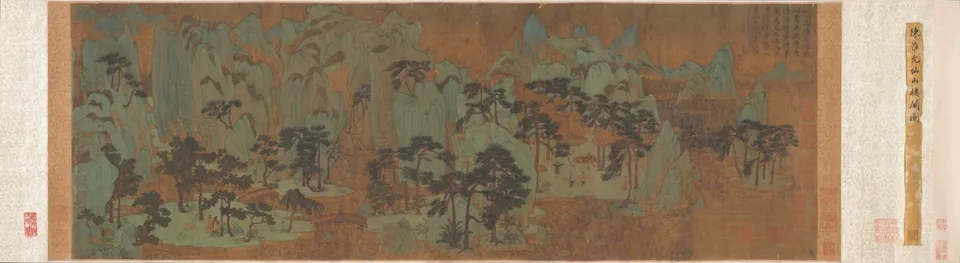
Blue-green peaks, small inhabitants, and a crane rider turn a broad landscape into an imagined place beyond ordinary geography.
The long format lets the eye move between sheltered valleys rather than settle immediately on one centre. Blue-green peaks enclose pine trees and small figures, while paths and openings connect their separate gathering places. The museum identifies ancient figures accompanied by deer and cranes, and a red-robed immortal riding a crane toward the imagined realm. That airborne visitor helps distinguish the scene from an ordinary topographical view.
The painting is catalogued under Chen Ruyan, while Ni Zan’s inscription is dated 1371, after Chen’s death. Ni praises the painting and mourns that no more works by Chen can be acquired. The museum places the idyllic landscape against the troubled transition from Yuan to Ming rule, when Chen supported rival rebel leaders before his execution. That context need not turn every figure into a political symbol. The blue-green peaks evoke an idealized antiquity, while the later inscription adds remembrance to the scroll’s imagined refuge.
The museum presents the political setting and nostalgic associations as context, not a key to every figure. A screen shows the whole scroll at once, unlike a gradually unrolled viewing experience.