Two acts of violence share a blue enamel field, linking a murdered archbishop’s cult with the central Christian story of sacrifice.
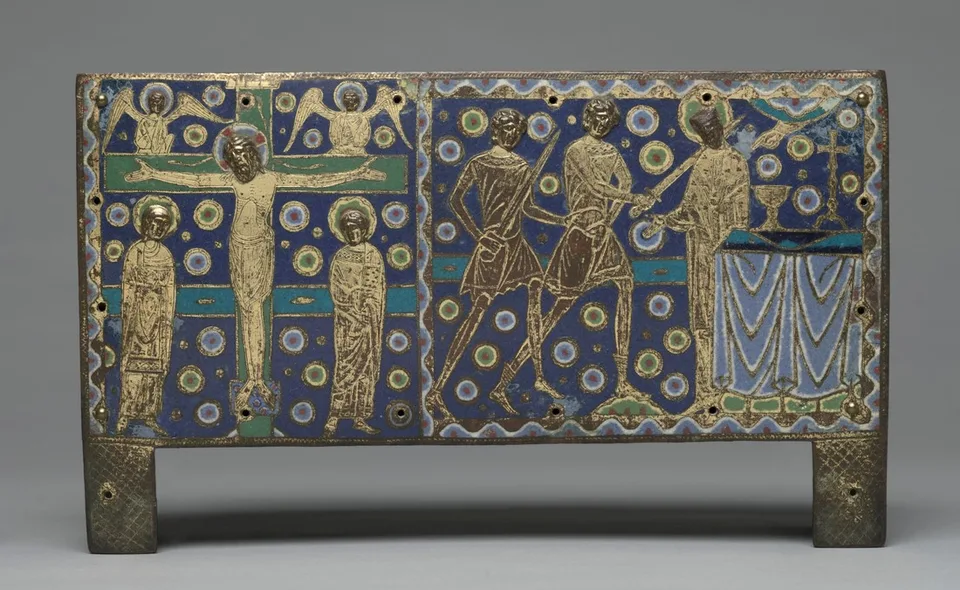
The two scenes are placed side by side rather than separated into different objects. A large cross organizes the left, while diagonal weapons animate the right. Gold-colored figures remain clear against blue enamel, and scattered round motifs fill the surrounding spaces. The plaque’s legs and border holes also keep its physical construction visible alongside its imagery.
Thomas Becket was murdered in Canterbury Cathedral in 1170 and canonized three years later. The museum connects the rapid spread of his cult with Limoges workshops producing containers for associated relics. This plaque once formed the principal face of one such shrine; the complete reliquary is not present. Its pairing of Becket’s martyrdom with Christ’s Crucifixion gives the later saint’s death a specific devotional relationship. The record credits Master G. Alpais and workshop, preserving collaborative production in an object whose materials and imagery made sacred history available through a portable, gleaming surface.
This is the surviving face of a reliquary, not its complete original container. The record does not establish which particular relics it held or prove their authenticity.
Why are the two scenes placed together?
Practise looking at Plaque from a Chasse for Relics of Saint Thomas Becket →