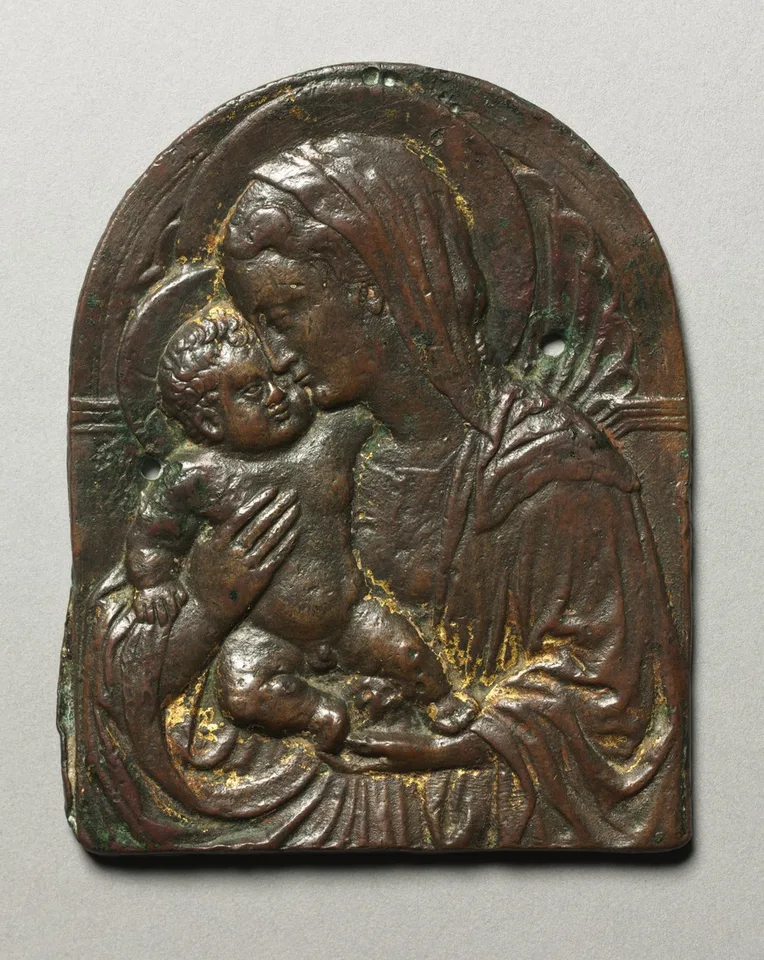
Two close faces fill a small bronze plaque whose holes suggest that private devotion may once have had a fixed wall position.
The arched boundary fits closely around the mother and child. Her head bends until the faces nearly meet, while the child’s lifted arms create a small bridge between them. Thick drapery folds run outward toward the edge, giving the intimate gesture a substantial material frame. Scattered gold catches the light over the darker bronze.
The museum credits the work to Donatello’s circle, rather than securely to the sculptor himself. It places such small plaquettes within Renaissance interest in ancient coins and medallions, while emphasizing their use for private devotion. Two holes suggest wall hanging, and the figures’ angles may indicate a position above eye level. These are evidence-based possibilities, not a recovered installation. Looking at the plaque as both an image and a movable object helps connect its close bodily exchange with the practical circumstances in which an owner might repeatedly have encountered it.
The attribution is to Donatello’s circle. Wall mounting and placement above eye level are suggestions based on holes and figure angles, not securely documented original conditions.