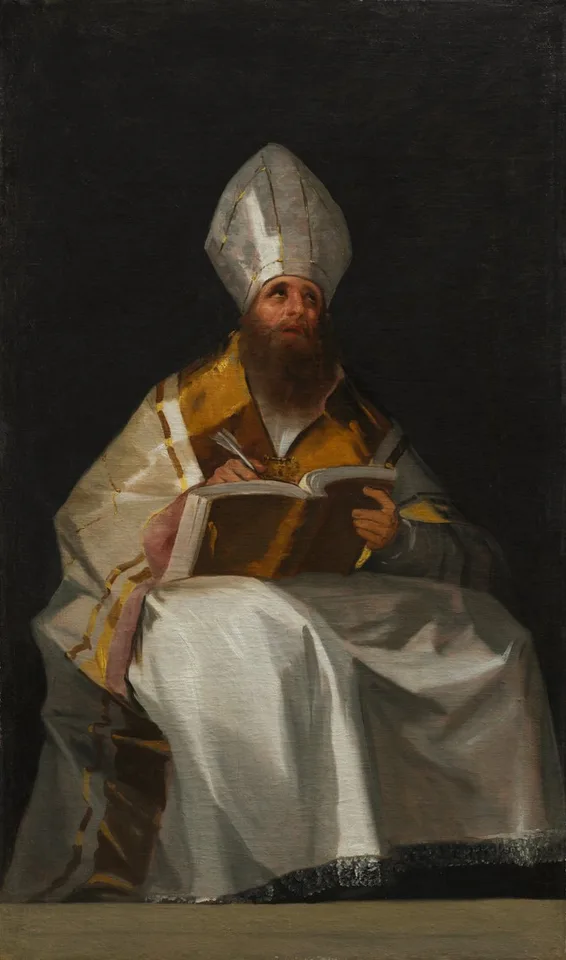
A book rests on a massive lap while the saint looks upward, suggesting a painting designed to be seen from below.
The bishop’s pale robe expands across the lower half of the canvas. Its large folds catch light in broad planes, while the dark ground makes the mitre and shoulders especially clear. The open book lies close to the center, but the saint’s eyes turn upward rather than remaining on its pages. Reading, writing, and contemplation are joined within a single seated pose.
The museum identifies Ambrose, the fourth-century bishop of Milan, and places this work in a series of four early Church fathers. Its large scale and low viewpoint suggest a position high on a religious building’s wall, although the original location remains unknown. The record links a possible commission to Spanish religious reformers who looked back to early Christian history. That context helps explain the choice of subject, while the visual evidence lets us test the more immediate question of how an image might address viewers looking up.
The proposed high placement and reformist commission are hypotheses, not a documented original installation. Ambrose’s upward gaze alone cannot prove the specific subject of his contemplation.