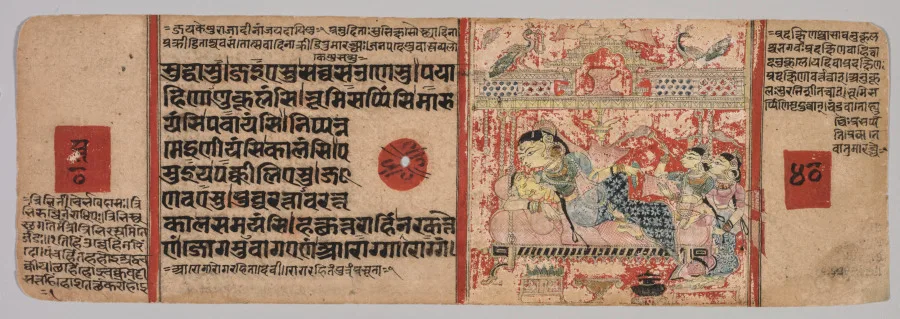
A mother and golden infant share a tiny painted scene, while a binding hole reveals how the surrounding page was handled.
The mother’s face and the small golden infant draw together within the crowded painted section. The museum identifies the scene as Mahavira’s birth, represented centuries after the life of this central Jain figure. Attendants with fly whisks honour mother and child on a suspended bed. The picture gives a sacred biography the intimacy of a mutual look, while costume, furniture, and service establish the significance of the event.
Move left from the painting into the written page. A hole in the central red dot once accommodated a binding string, reminding us that this leaf belonged to a handled manuscript. The museum connects its paper support with a transition from palm leaves in Jain bookmaking during the preceding century. Small marginal comments also extend the page beyond the main text and illustration. Image, writing, commentary, and binding occupy the same narrow object, so its format is as informative as the represented birth.
The painting is a later devotional representation rather than an eyewitness record of Mahavira’s life. Wear makes some small features difficult to separate, and a single detached leaf cannot reconstruct the complete manuscript’s reading sequence.
What does the hole within the central red dot tell us?
Practise looking at Birth of Mahavira, folio 40 (verso) from a Kalpa-sutra →