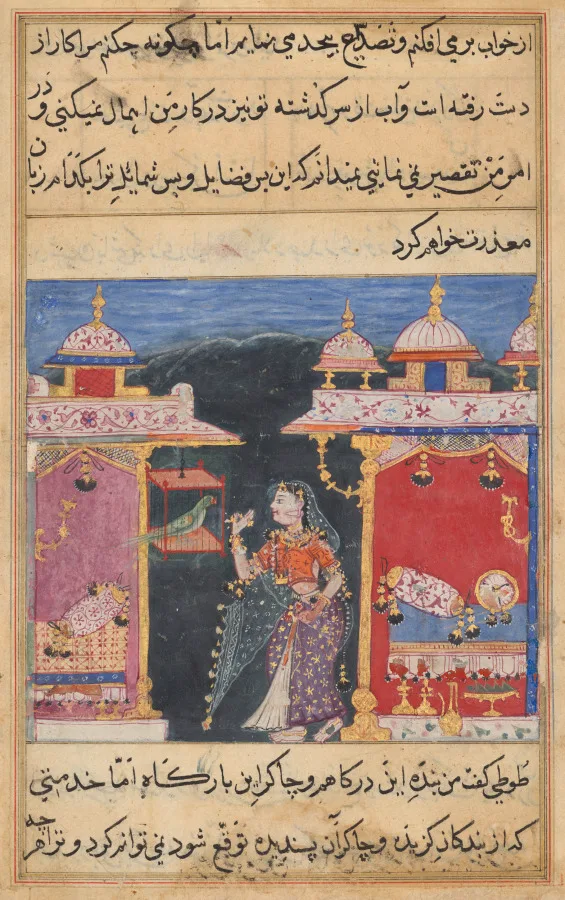
A tiny bird holds a woman’s attention, turning the space between cage and doorway into the centre of a story.
The important exchange occupies surprisingly little of the page: a woman turns toward a small parrot. The surrounding beds, patterned textiles, and ornate architecture make a richly furnished setting, but the bird’s speech supplies the action. This leaf belongs to the Tuti-nama, or Tales of a Parrot. The museum identifies it as the beginning of the seventh night, when Khujasta is again drawn into listening before leaving to meet her lover.
In the framing story, the parrot repeatedly starts an irresistible tale. By the time the story finishes, daylight has arrived and Khujasta’s planned secret outing becomes impractical. The miniature therefore pictures attention and delay rather than a spectacular event. Writing above and below carries the larger sequence that a single image cannot show. Although made at Akbar’s Mughal court, the painting retains approaches the museum associates with earlier Indian traditions; a court setting does not require every participating artist to use an identical style.
The single leaf does not show all fifty-two nights or the passage from night to dawn. The narrative comes from the manuscript’s story, while the photograph shows one selected encounter within it.